The Deuce Horizon (Where did my life go wrong?)


I sat down tonight to write a blarg, and all I could think about was poop.

Not my poop. Let’s get that right. Baby poop, cat poop, dog poop… I’m inundated by Poops Which Are Not Mine, and inevitably, regrettably, it oozes over (ew) to my recreational writing. And as I sat here, pondering the poop I was trying hard not to ponder, I realized that my life has taken a series of unfortunate turns to bring me to this point.

To be clear, that point would be the point where I feel compelled to write entire blog posts about poop.

It wasn’t always this way. My life used to be ordinary. Go to work. Talk to some friends. Party hard on the weekend and reload on Monday, then do it again. There’s very little about poop in the cycle that used to be my life, except of course for the unmentionable one or two per day, and it certainly didn’t occupy my thoughts the way it does recently.

But then I got married. And we got some cats. And some dogs. And now we have a couple of kids. And at some point, my life changed over from never think about poop even when poop is happening to poop is the gravitational sun at the center of my universe.

Cleaning poopy diapers. Trying to get the sprout to poop on the toilet. Baby sticking her foot in the poop while I’m trying to clean the poop. Cat poop in litter boxes. Cat poop out of litter boxes. Letting the dog out to poop. Dog pooping on the carpet because we were at work all day. Cats dragging their poopy butts on the carpet. Carrying kids’ poopy diapers straight out to the curb because they’re too horrific to keep bottled up in the house.

Didn’t the Talking Heads have a song like that? This is not my beautiful life! Who knew I would hear that lyric and think only of poop.

Here’s a true statement, without embellishment: I have to deal with Poop Which Is Not Mine at least four or five times a day, which is enough, I think, to cause anybody to fixate a little bit. In short, for me: poop is a problem.

And the problem goes beyond the poop itself (which, let’s face it, is more than enough problem in its own right). Since I deal with it so much, I fixate, as I believe I may have mentioned. And that means it’s floating around in my subconscious, not unlike turds in the crapper, just waiting to back up the septic system of my brain. So I sit down to write a blarg topic, and all I can think of is crap. Literally.

There’s the second problem. Who wants to read a blarg about poop? Nobody, that’s who. To be honest, I don’t even want to be writing about the poop. Even thinking the word makes me feel icky, let alone typing it out over and over again as I’ve done tonight. Sure, I’m desensitized to it in a sense, but then it all comes bubbling back up while I’m sitting here trying not to think about it.

This is not a blarg about poop. This is not my beautiful life. I want this blarg to be a place where I write about writing and funny and quirky and interesting things that happen to me and that flit through my mind like butterflies through a fragrant meadow, but the percentage of posts about poop is really skewing the numbers around here.

And here, I’m exacerbating the problem by writing an entire post solely about poop.

If there’s a poop event horizon, I’m pretty sure I’ve crossed it by now. The poop in my life (Poop Which Is Not Mine, I hasten to add) is taking over, and I am not okay with that.

But the fact is, I don’t know if I can be saved. I have several years yet before I can stop thinking so much about these particular biological functions in my children… and let’s be honest, even when these functions are done, there will be an entirely new host of biological functions I will have to worry about.

If nothing else, I can perhaps serve as a warning.

If there’s Poop Which Is Not Yours in your life… in any capacity at all… run. Get out now, while you still can. The word “poop” appeared thirty-five times in this blog post. That’s too many for any sane person.
Kid Art: In which my 3-year-old teaches me a thing or two about creativity


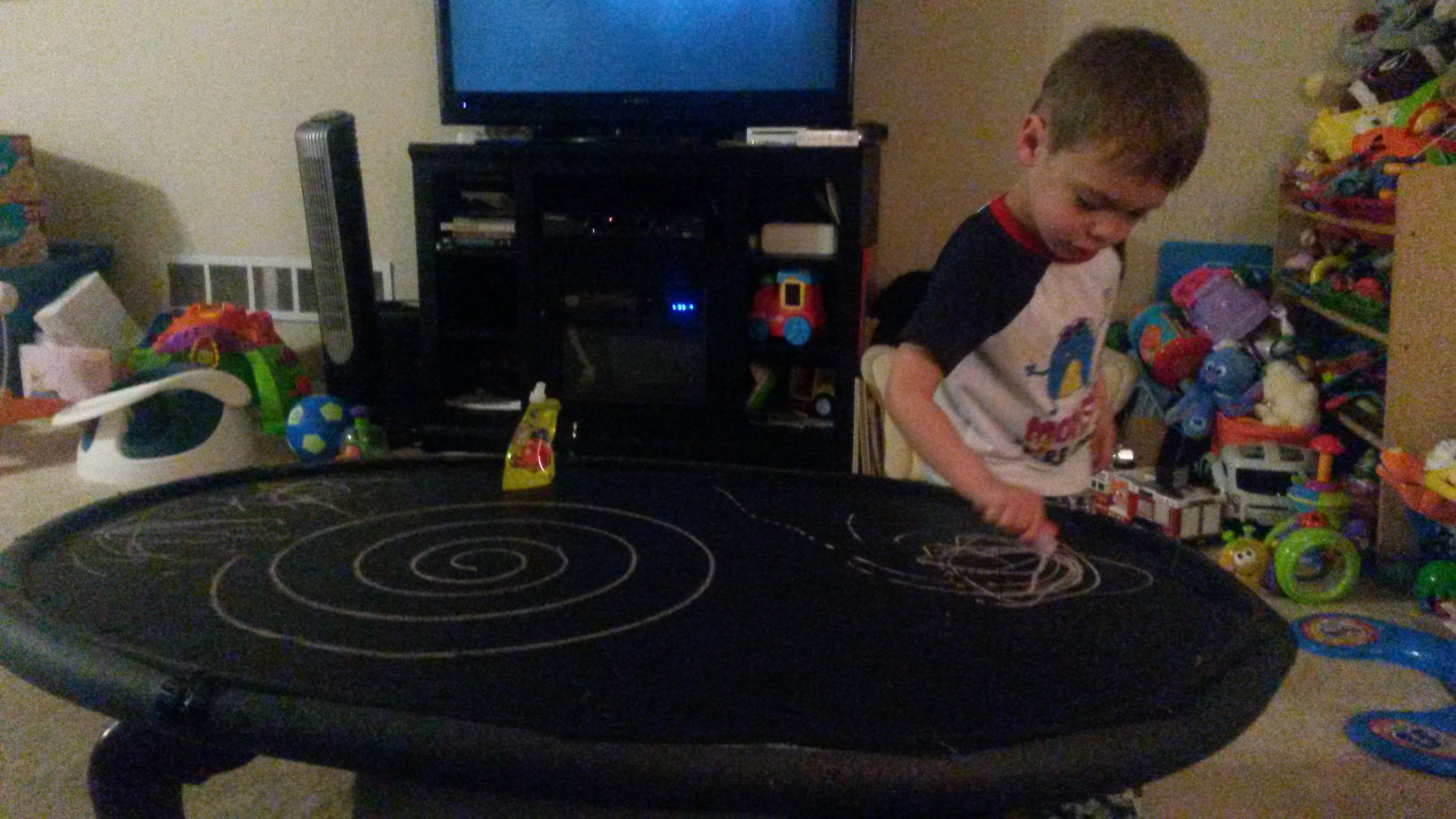
I’ve been sitting around for the past couple of days when I have a spare minute, watching my son playing with his new chalkboard table.

wpid-20150516_204505.jpg

Just a sidenote: if you have kids, and the kids are in any way artistically inclined, you owe it to yourself to make one of these. Just take any old crappy coffee table, go to Home Depot and buy a $15 can of chalkboard paint, lay down a couple of coats on top of the table, and let it dry overnight. Easiest and most rewarding DIY project I’ve ever undertaken.

Anyway, my boy has a dubious approach to the thing. He loves coloring but lacks any kind of… I don’t want to say the motor control, because he seems to be doing what he wants to do… what I’m trying to say is, the things he draws aren’t shapes I recognize from this universe. Everything looks like a sea urchin, or a squiggle, or maybe just one long shapeless line. He will draw these designs, over and over again, one on top of another, until the table literally looks like a bucket of chalk vomited all over it, then he will gleefully take a rag, wipe the table clean, and start anew.

The crazy thing is, he knows what he’s drawing. I can point to this squiggle, say “Sprout, what’s this?” And he will say, confidently, “apple.” Point to this two-foot-long wobbly line: “water fountain.” This wonky-looking unidentifiable polygon: “dinosaur.”

Which is, in itself, adorable and delightful; hours of fun just asking the boy what he’s drawn and trying to imagine how exactly he sees these things.

But it goes a level deeper.

Because sometimes, he’ll decide to draw something himself. “I going to draw a car.” Okay, sprout, go ahead. *scribble, scribble.* He works with such intensity sometimes that I find myself looking over his shoulder to see exactly how he’s going to describe the shape of a car. Of course he isn’t. It’s just a shapeless blob of color. But he will finish, stand back to admire his work, and say, “Oh, that’s not a car, that’s a banana.” And then go on drawing something else.

Or I’ll ask him to draw something. “Draw daddy,” I’ll say, and his eyes will light up with glee, and he’ll begin the painstaking, arduous work of outlining my bald head and bugging eyes and ha ha just kidding, he scribbles a little bug-splat of color, stands back and looks, and announces to me, “Oh, that’s not daddy, that’s blocks.”

This little game simultaneously cracks me up and creeps me out, because I know he knows his shapes from any of the myriad of little puffy books or kids’ youtube videos we’ve looked at together. He can identify a triangle without batting an eye, can tell the difference between a duck and a penguin, and knows his boats from his spaceships. He knows things. But he also has the ability to recognize his nonsensical artistic representations of these things as these things, despite the fact that the two bear no resemblance whatsoever to one another. And I know he’s not just making it up, because he can lay down five or six spaghetti-tangle pictures which he names as completely different things than he originally set out to draw, and then he can point to each one again and tell me what it is with 100% accuracy. And I’m sorry, if he’s just making this stuff up off the top of his head, I don’t think he has the wherewithal to piece together a fiction. I really think that to him, that squiggle somehow says, “dinosaur,” while this one says, “grocery store.”

It’s a nifty little parlor trick, I guess, for a three-year-old to be able to do, but I started thinking about the boy, and I started thinking about creativity and art in general, as is my wont, and then came the lightning strike moment. The moment where the mundane, not-at-all special and completely-by-accident whimsical actions of a toddler shake my preconceived notions of the world to the very roots.

How many times have I found myself banging my head against a moment in a story? A character who just doesn’t seem to behave the way I want him to? Or a fiddly bit of plot that just won’t jive with the pieces all around it? Or an element that I need for the story to move forward, but I can’t figure out how to work it into the story? Or, maybe, the problem is more intrinsic to the story: I’m trying to write a science fiction thriller but it detours into comedy, or I’m trying to write a lighthearted romantic-comedic bit, but suddenly things feel all melodramatic? I always talk about how stories have lives of their own, how the characters have drives and desires buried within them that are sometimes a surprise even to me, but I still find myself trying to force square pegs into round holes. No, the story is meant to be this way. No, I need to focus on this aspect of the plot now. No, I’m trying to send this thematic message.

But not my son. The art takes him in a new direction, he’s happy — even ecstatic — to detour and abandon the thing he thought he was working on. The story changes, he changes with it. He has no preconceived notions of what it should be, there is no consideration for creating the wrong thing. The thing he creates is fine by him, whether it’s what he set out to create or not.

And I think that’s pretty freakin’ awesome. Because when you don’t get hung up on the problems in your story, when you don’t wander off into the bog of unrealized expectations, you can process the project in front of you with the unbiased perception of… well, of a child. To a kid, things are what they are. And there’s nothing wrong with that.

The Long Con


I’ll be honest, as I’ve been in the past: I have no idea what I’m talking about. I’m making this all up as I go along. All of it. Life. Fathering, writing, teaching, running, husbanding… you will find no stores of expertise here, and precious few pearls of wisdom in a heap of dusty crumbs of idiocy. But you’ll also see that that doesn’t stop me from pretending.

I use this blarg all the time to talk about things I pretend to know a lot about. I dispense all sorts of marginally intelligible writing advice, I wax eloquent about the virtues of distance running, I tell funny stories about baby poop that hint at, but never actually deliver, profound lessons about life. Why bother doing all this, when I’m not actually a writing guru, not actually a running yogi, not actually a SuperDad?

Because I want to be those things.

But here’s the trick: you don’t get to flick a switch and start being those things. The road from where you are to where you want to be is beset on all sides by the iniquities of the weak and the tyranny of evil men. (Or maybe that’s only if you’re Samuel L. Jackson.) Oh, you want to write? There are thousands of writers out there. What makes you think you’ll make it? Good point, you think, and give it up, wisely saving your efforts for more productive endeavors. Oh, you want to start exercising? What’s the point? Most people fall short of their exercise goals and give it up anyway; you might as well hang it up now and save yourself the heartache. Too right, you think, and cancel your gym membership.

But where do those voices of doubt and dissent come from? Sure, there are haters out there that will poop on your dreams and ask you to thank them for it, but the louder, more convincing voices are the ones in our own heads. I know I can speak for myself when I say I’m my own worst critic. The voice in my head that tells me I can’t do things speaks like Morgan Freeman with a 50,000-watt station broadcasting down to the very marrow of my soul. It’s overbearing, constant, undeniable. How do I overcome it?

By pretending.

I’m not an expert writer, but I can pretend to be one. And I can bang out over 1,000 words a day on average despite my full-time job and part-time daddy duties as if I were an expert writer. And I can shovel out advice like a steamshovel about my experience and pretend to know what I’m talking about to give the illusion that I actually do know what I’m talking about. Because that’s what experts do. They look confident. They walk the walk and talk the talk. You wanna be that thing? You have to start doing the thing.

Nobody’s born a brilliant novelist. No athlete pops out of the womb running ultramarathons. The people that do those things have the same voices of doubt that you or I have. The human experience, for all its vast variations, striations, complications and salutations (whatever, I ran out of good rhymes), is actually pretty standard. We get a life, we get some challenges, and we either overcome them, or we don’t. If you want to get ahead, you have to learn to be a con man.

But not so that you can run a swindle on some unsuspecting rubes. (Though I guess that helps, too.) The con you want to run — the long con that you work for years and years — is on yourself. You have to fool that inner voice of doubt into believing that you’re not to be doubted anymore. You have to fake it til you make it. That means pretending to be the thing you want to be, every day, in public and in private, until one day it’s no longer a con and you are that thing.

Wanna be a writer? Write buckets of garbage. Drivel, drivel, drivel. Pile it on and pile it on and write boring stories and hackneyed narratives and cliched tripe and nonsensical dialogue until one day, when you’re not even thinking about pretending to be a writer anymore, you’re simply writing because that’s what you do now, you write something and it’s not half bad, and your inner voice of doubt will say, as if you’ve just demonstrated that the world is not, in fact, flat, as he previously believed, “oh. Well… I guess that makes sense, then.” And BLAM KAFIZZLE, you’re a writer.

Wanna be a runner? Get outside and run until you can’t anymore, and then stop and walk home. Then do it again. And again. And again and again and again, until you can run for a mile, and then for two miles, and then one day you’ll be out for your daily torture session, except you’ll realize it’s not actually torture anymore, it’s rather enjoyable, come to think of it, and you’ll start looking forward to those runs. And when people ask you what you’re doing this weekend you’ll respond airily, with a casual wave of your hand like you’re just going out for eggs, “oh, I’m going out for a 10k this morning,” and they’ll be all like “whoa, you’re running in a race?” and you’ll be all “no, that’s just what I do — I’m a RUNNER NOW.” And you’ll stomp on their toes for emphasis. Or maybe not. The stomping is optional, though it sends a good, strong message.

Point is, all the old adages are true. If you believe you can or you believe you can’t, you’re right. A thing always seems impossible until it is accomplished. You have to fake it until you make it.

The power of sticktoitiveness (not a word, but yeah, totally a word I love) cannot be overstated. If you wake up every morning determined to accomplish a thing, and then take the steps and do the work necessary to take one step on that journey EVERY DAY, you can get there.

But what do I know? I’m not an expert.

I’m only pretending to be.

This post is part of Stream of Consciousness Saturday.

Not By Any Other Name


For so long I struggled with a question of identity. Actually, struggle is the wrong word, because I wasn’t thinking about the issue at all, but by virtue of not thinking about the issue, I was missing out.

Okay, that’s vague as hell. Let me try again. Self-perception is a big deal. Not so much in thinking of yourself as a big deal (although I guess that’s maybe not a bad thing now and then), but I mean just the way you think of yourself in general. The way you define yourself matters.

Sounds obvious, right? But it’s the simple truths that are the most powerful. For a long, long time, I thought of myself in a really negative way. Not actively — I didn’t sit around thinking to myself: “I’m a loser, I’m never going to amount to anything, I might as well just not try.” But that perception was lurking in the back of my mind nonetheless. I hadn’t amounted to anything, so I didn’t know that I ever would amount to anything. I had aspirations, but I had no confidence that I could achieve them, so I didn’t bother even thinking of myself as being on that track.

Case in point: Writing. I always wanted to write, but the idea of actually writing a book felt so insurmountable I just took it for granted that I could never get it done. Without really thinking about it, then, I named myself not-a-writer. By the same token, I could define myself by virtually any yardstick you could think of. Not-an-astronaut. Not-a-millionaire. Not a super-genius. But there’s only so much you can learn about a thing by determining what it isn’t, and that goes for yourself, too.

So, a little over a year ago, I decided to try something different. I told myself, you’re going to try being a writer. And so I started thinking of myself as a writer. And lo and behold, I suddenly found myself more committed than ever to writing well and productively and regularly. Well, that was pretty cool, so I started thinking of myself as other things, just to see what effect it would have on me. I never thought of myself as much of a dad, but now and then lately I remind myself, you’re a dad now, and I find myself being just a little more conscientious with my kids.

I’m willing to bet that this works with almost anything, because as good as we are at fooling ourselves about life in a direction that hurts us (I’ve got plenty of time for that project, or a few extra cookies won’t hurt), we can fool ourselves in a positive direction, too.

So, this post is to remind myself that I’m a writer. And a runner. And a dad and a husband. And a teacher. And a thinker. And a goofball and a nerd and a reader and a slew of other things. Positive things.

The names we give ourselves, I think, become the names we make for ourselves. So pick good ones.

This post is part of Stream of Consciousness Saturday.

Little Victories Fuel Big Victories


If you’re like me, a wannabe writer trying to figure out how to make the dream happen, you might be struggling to write every day. I know I did; writing the first draft of my first novel was as challenging as pulling the teeth from an enraged baboon while whistling “Happy Birthday” backwards. Sure, you start off full of chutzpah, ready to slay dragons and save the world every day, but the honeymoon only lasts so long. After a few weeks, you find yourself tasked with churning out more and more words, even though you’ve already used up your good ideas — or even though you don’ t know how to get to the good ideas.

That blank page stretches out in front of you like a wasteland, cruel and without end.

Some days are better than others, but every day is hard. Not just because you have to claim your time from the jaws of your enemies with blood and fire, but because you have to keep the creative engine churning, you have to keep the cursor moving, you have to keep that word counter ticking over like the odometer on a road trip.

Now, I’m not an expert. I’ve yet to make a dime off of anything I’ve written creatively, so I can’t claim to know any better than anybody what you should do to make any money at this endeavor. But I do know that if you aren’t writing, every day, you’re handicapping yourself before the race has even begun. Momentum matters, and if you keep the ball rolling a little every day, you don’t have to kickstart it from a dead stop again. To that end, if there were one piece of advice I’d offer to anybody trying to start writing, it’s this:

You need a daily goal. A set amount of progress that you will, one way or another, put to “paper” one way or another before today turns into tomorrow. Momentum matters. Achieving this goal every day will keep you sliding forward like a glacier. You can’t set out to say you want to write eighty thousand words by November and hope to get there by focusing on the eighty thousand. It’s too big. You might as well be thinking about climbing the summit of Mount Everest when you haven’t even left base camp. It’s a good goal to have, but you’re not going to achieve it today. Or tomorrow. Or next week. And when you fail to achieve that goal, you will lose gumption, you will lose drive, you will lose the confidence that you can achieve this thing. What you need is to focus on what’s in front of you and achieve that, however big or small that goal is. What’s your daily goal? 100 words? 300? 2000? It depends on the kind of time you have available in your days (or, more correctly, the amount of time you can prise from your day’s cold, dead fingers).

I find that, on a normal workday, I can usually find about 45 minutes to write, and that tends to be enough time for about 900 words.

Now, 900 words assumes I’m able to write productively and without pauses for almost the entire time, and that’s not always the case. So my “on paper” goal per day is 600, even though I’m really trying for 900. 600, therefore, is what I want to accomplish so that I can feel I’m not neglecting my writerly duties. 900, however, makes me happy.

How does it go, writing 900 words a day?

A little something like this:

0-100 words: Man, this is hard. Why did I decide to do this, again? I’m not sure what I should be writing at all. (re-reads yesterday’s work.) Okay, maybe this can happen, or maybe this character can set this trap… I dunno, it sounds lame. But if I don’t get to work, I’m not getting my words. Whatever. Just write something.

100-300 words: Well, I guess this is happening. I’m not sure I love what’s happening, but it’s happening. Make sure to keep that character involved. Think about what this character is thinking. Where is this heading? Just keep writing.

300-500 words: Okay, I like what’s happening now, and I see where it’s heading. Maybe, though, it doesn’t make sense for this character to say this thing now, or to take this action now, but I’m not sure how else it could go. Don’t think about it, don’t think about it, don’t think about it… fix it later.

500 words: SHARKNADO. I just realized the perfect thing that should have happened earlier to set up the thing I just realized needs to happen now. Do I go back and fix it? Press on and make a note? (This is usually where I get up and walk around for a minute to rearrange my thoughts.)

500-700 words: I’m either going back and inserting an alternate text to something I already wrote, or I’m forging ahead full-speed with today’s beats. Either way, at this moment, I’m in a state of flow, just letting the words come on their own and keeping up with the narrative as quickly as it’s unspooling in my head.I don’t even check word count during this step. It just happens.

700-900: Flow continues and the possibilities for future events are exploding like popcorn, one after another, each one showing a road to the rest of the novel that might develop into something or that might wither on the vine. There’s no telling which one is the right one, though, so I grab hold of one and ride the wave while it’s high. At some point in this range I realize that I’m almost out of time for today, so…

900-1???: I use my remaining time to find a stopping point. I used to try and finish a beat, but now I like to either stop right in the middle of one or just at the beginning of a new one. That way, when I come back to write next time, I still have fresh in my mind some semblance of where this scene is going. I don’t usually want to stop writing at this point, but by this time there are other responsibilities banging on my door, either literally or figuratively.

So that’s pretty much every day. I push through five days a week like that when I’m drafting. I aim for a blarg post about every other day or when I can manage it, but I don’t stress about the length of the posts anymore (I used to shoot for 1000 words… yeah, this post is over 1000 already, but sheesh, that’s a lot in a day).

900 words might seem like not very much to you. Or maybe it seems so lofty as to be insurmountable. Point is, it’s been a sweet spot for me: It’s a challenge to get there, but not so daunting that I have to struggle every day to make it. But it’s not so easy that I can do it without any effort at all. It’s significant enough to give me a pick-me-up when I meet the milestone, but not so significant that I feel I can’t make it. Pick a goal that stretches you a little bit, but one that you can realistically reach from where you are. Little victories fuel big victories.

I’ll admit I’m feeling somewhat at sea with my current story. There are loose ends all over the place, I’m still getting a feel for the characters, and I’m not even 100% sure where I want the story to go. But what I do know is, I’ll be writing about 900 words a day every day for the next few months. If I can keep to that schedule, then long about September, I’ll have my second novel drafted.

How do you eat an elephant? One bite at a time.