Science Sunday with the Mythbusters


I’m a big nerd.

I dunno if you know this or not.

I love science fiction, astronomy, physics… I can’t get enough. I subscribe to Crash Course Astronomy on youtube. I am counting the days to the new Star Wars movie. So I guess it was inevitable that I would love a show like Mythbusters, which takes a scientific look at everyday turns of phrase and bits of movie magic to see if there’s any actual truth to them.

After filming their final season, the show’s hosts have been on a tour lately, doing speaking engagements and sharing some of their favorite moments about the show around the country.

Last night, they were in Atlanta.

And because my wife is awesome, she got me tickets to the show for my birthday back in July.

Now, I’ll be the first to admit that the show is a little nichey; that while it has its fans, it’s probably not widespread enough in popularity for most people to even be familiar with it outside of maybe seeing a rerun of it on the weekend. Still, they basically sold out the Fox theatre in downtown Atlanta. Further, the audience was wonderfully diverse: people of all ages and all ethnicities filled the rows, but maybe more impressive were the families, especially those with kids as young as six or seven. And I will happily admit that I spent the bulk of the show with a big dumb fangirly grin plastered to my face.

Still, I didn’t know exactly what the show was all about. I thought they’d show some clips from the TV show, answer a few questions, maybe do a few live demonstrations. But it was a lot more than that.

The show was full of lovely little moments. My heart warmed when they called their first volunteer up onto the stage — an eleven year old girl — who proudly proclaimed that math was her favorite subject in school. Adam talked about some experiments they had run but never been able to use on the show, like a ridiculously explosive, easily accessible chemical that they are forbidden to disclose, and a lab rat that turned cannibal during a food experiment. The usually stoic Jaime got emotional when asked about his most frightening moment on the show.

Simply awesome.
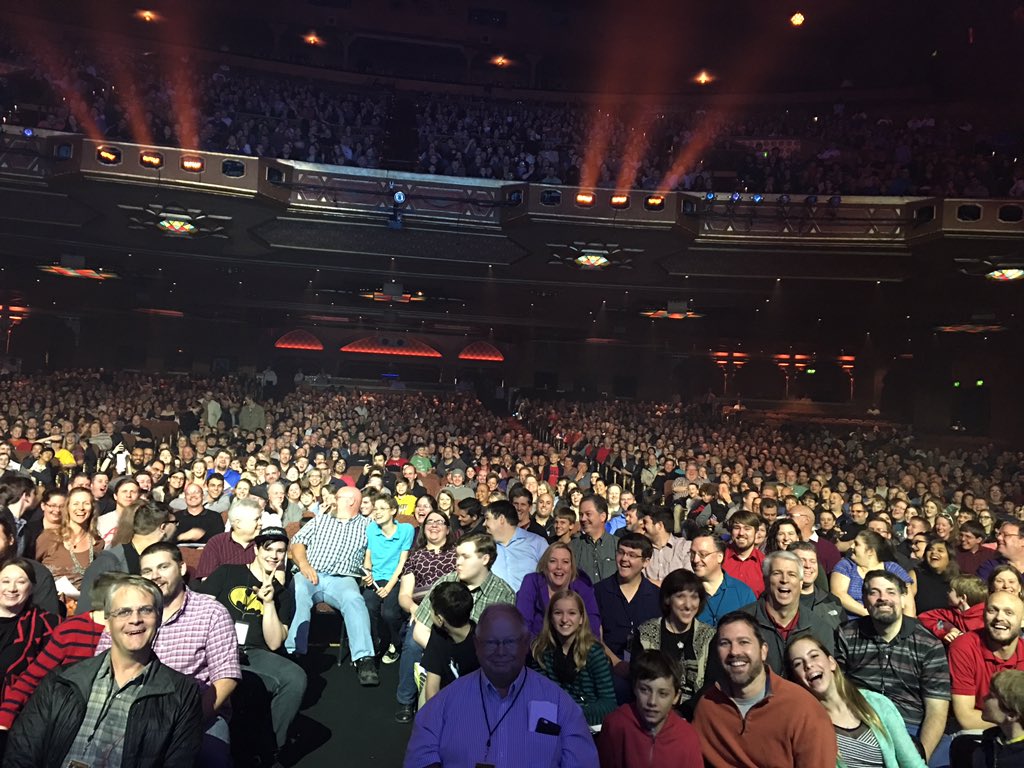
(My brother and I are about thirty rows back on the left.) You can tell based on my formless face-shaped dome head.)

But what I really want to talk about is Adam Savage.

Adam Savage is one of the nerdiest nerds around, putting a gusto and chutzpah into his geekiness that’s really enviable for a more low-key geek such as myself. While I expected to see a few neato science experiments and hear a few funny stories about being on the set (and there was certainly plenty of that), what really resonated with me was the opening moments of the night, wherein Adam told some stories about growing up geeky and what led him to the sort of thinking and experimentation and self-instruction that would eventually lead to a career doing special effects for movies and television and web series about science.

Being the big nerd that I am, I whipped out my pencil and notepad and began scribbling.

Out of the evening, I came away with a list of reading material that I need to look into (100 Years of Solitude, and the works of Raymond Chandler) and some lovely poignant aphorisms about science in particular and learning and being human in general. They were even, believe it or not, applicable to writing. So I thought I’d share a few of them here.

  1. The deeper you go, the harder it gets. Adam told a story about learning to juggle, starting with the absolute basics and eventually undertaking to learn tricks. At first, the gains and improvements came quickly and readily, and he was able to master new facets of the skill every couple of days. (As a fellow novice juggler, I can certainly identify.) But very quickly, you come up against a wall beyond which the improvements become harder to achieve. While he mastered basic juggling in under a week, it took him well over two weeks to master even a few simple tricks, and he found he simply didn’t have the drive or the time needed to undertake it further. As a result, he’s a decent if not impressive juggler. And, well, that’s like writing, or hell, like anything really, innit? Anybody can do it, anybody can undertake to string sentences together and even craft a narrative. But if you want to be good, if you want to impress people with your talent, well, you’ve got to slay a whole other sort of beast. You’ve got to live and breathe with your work for long months and years, you’ve got to study, practice, think about language, try and fail in a thousand different ways. In short, you have to put in the miles. I’d wager that most would-be writers don’t have the gumption to do that. It remains to be seen whether I do.
  2. The Champion of one notch above mediocrity. As a result of all this, he became just barely decent at a lot of things: he had fascination with tons and tons of different skills and ideas, but didn’t have the follow-through to devote himself to get really good at any one thing. As a result, he was seasoned in lots of areas and knew a little bit about a lot of subjects, but never became an expert in any of them. I think we could all take a page from that book. There’s value in trying lots of things, even things you don’t expect to plumb the depths of (see my collection of Flash Fiction for examples). Out of those tiny forays comes growth, comes a broadening of the experience.
  3. Failure is always an option. If you watch Mythbusters, you’re familiar with this little epithet already; rare is the episode that doesn’t feature an experiment blowing up — sometimes literally, often dramatically — in their faces. But this isn’t a setback. In fact, they seek this moment because if you simply skate through an experience and everything goes to plan, you maybe enjoy a bit of success, but you don’t really learn much. Failure, however, is a fantastic and ruthless teacher; nothing teaches you how not to suck like picking over the charred and smoldering remains of your failed forays beyond mediocrity. Unless you failed at skydiving. No second chances in skydiving.
  4. Art and science are just two different kinds of storytelling. This one shook me to my core. I like to think there’s something magical and even otherworldly about storytelling, in the artistry of a nicely turned phrase, the cleverness of a well-tuned plot. But as with so many things, the moment I sat down to think about it, the pieces started sliding into focus like a Magic Eye painting. Stories tell us why people do the things they do. Science tells us why the world is the way it is. We love art because it speaks to worlds and people and emotions that might be, and we love science because it shows us the magical things we never knew about the world we currently inhabit. Furthermore, I don’t think you can have a good story without science — even if it’s just the inexact science of human interaction — nor can you have good science without a bit of art — the elegant organization and tracking of variables, the spiraling recursion of repeatability.

I’ve gone on enough, but suffice it to say that while I went to the show expecting a bit of fun, I came home with a whole new respect for a show I once thought of merely as a diversion.


The Actor’s Nightmare


Why, nearly ten years removed from the stage, do I still get the Actor’s Nightmare?

If you’re not familiar, the Actor’s Nightmare is a simple but prevalent one among denizens of the stage, in which a performer finds himself thrust into a performance for which he is woefully unprepared.

Common tropes of the dream:

  • You learned all your lines, but have forgotten them and everybody stares dumbly at you as you “um” and “uh” your way through.
  • You never learned all your lines, but somehow made it to performance night anyway, and everybody stares dumbly at you.
  • You know your lines, but are unable to speak, and everybody stares dumbly at you.
  • Your costume is ridiculous or unfinished or ludicrously fails to fit you, and you must go onstage in street clothes, naked, or in the idiotic costume anyway.
  • The set is unfinished or worse, still in active construction, and your performance takes you through a minefield of sharply upturned tools, unsteady platforms, and other threats to life and limb.
  • Your performance is brilliant, but the audience is completely empty.
  • Your performance is an utter travesty, and the audience is completely full.
  • Your performance doesn’t matter, because the audience is full of T-Rexes who fall upon you and your fellow actors in a bloodbath of Shakespearean epithets.

Every actor in every performance ever has played out all the ways a show could go wrong in his mind multiple times throughout rehearsal for said show, and in the Actor’s Nightmare they all parade across the screen of our minds with the saucy abandon of a dog rolling in roadkill.

I’ve had the Nightmare ever since I started with theater. I will probably have the Nightmare my whole life, seeing as the theater was such an enormous formative element of my salad days. It’s just too much a part of who I am, I think, for me to ever be rid of it.

Still, why does it persist?

I don’t buy very much into dream interpretation, except in the broadest sense. If somebody tells you that because you dreamed you were falling from the 37th floor of an office building into a dumpster full of unicycles, you will soon find a new job at the office of Forestry under a supervisor named Shwampa or something… that’s garbage.

But the Nightmare, I think, is just another manifestation of doubt, of anxiety, of the rampant feelings of inadequacy that so many of us have. Notice in the list that a common thread is “everybody stares dumbly at you,” as if you’re out of place or you’ve wasted their time. Well, that’s a very real and present fear in the life of this particular writer. Also recurrent is that idea of things being “unfinished” or “unprepared,” which, well, yeah. I never feel particularly ready even to get out of bed in the morning, let alone to ply my trade as a wordslinger (though I did optimistically and automatically call what I do a “trade”, so maybe there’s something there).

Point is, there’s an undercurrent of doubt behind everything I do, no matter how brashly or confidently I brag about it. I don’t know, for all that I love my kids and my wife, how good I am at being a father or husband. I’m maybe a decent teacher, though I am regularly in class thrust up against the reminder that I don’t really know what I’m doing up there. I fancy myself a decent recreational runner, but I’m definitely not winning any trophies these days, and I’m always afraid I’m going to injure or re-injure myself. And as for my writing, well, I talk a good game, but no matter how many words I write, the Howler Monkey of Doubt is right there, with his empty eyes and his judgmental grin.

wpid-scragz.jpg

Of course, the upshot is that the Nightmare fills me not with the abject howling terror of being devoured by an audience of T-Rexes (okay, sometimes). Rather, I wake with the slightly bemused SOMETHING of watching a couple of cats wrestle for a moment and then lick each other’s butts. For a moment, it was scary, but now it’s just a weird thing that happened. The Nightmare is a reminder that, while that doubt can be crippling in the moment, it’s one hundred percent a creation of the mind.

The truth is, I’ve never gone on stage unprepared.

Or naked.

Or in front of a bunch of T-Rexes.

But maybe the thought that I may one day have to will help keep me sharp.

You Don’t Need NaNoWriMo


It’s that time of year again, when the leaves are changing, the temperature’s dropping, and established and would-be writers around the country are hunched over keyboards and stacks of paper, pounding with slowly numbing fingertips on worn keys as they push, strive, claw and crawl to make the 1667 words per day needed to add up to a 50k word novel at the end of 30 days.

It’s NaNoWriMo, and that means if you travel in writerly circles, as I do, your feeds are blown up with this weird unsayable moniker, with the braggings and boastings of those who are shattering their daily word count goals, and the wails and lamentations of those who aren’t. It’s cacophonous and wearying, viewed a certain way, or inspiring and invigorating, viewed another.

Personally, I won’t be partaking. I didn’t last year, I won’t this year, and I don’t see the need in years to come, for that matter. But that owes more to my personal feelings on what motivates us than it does to the little internet carnival that NaNoWriMo has become.

As a motivational tool, I think NaNoWriMo is pretty awesome. Anything that can get people thinking creatively and telling the stories locked away in their dark, squishy little hearts is a good thing by me. And there is certainly something empowering about seeing the hordes of writers taking to the internet, each with a dragon to slay that is unique and personal and wholly their own, but which is at the same time a dragon that the writing community sets out to slay together. Swords made of words, axes of pages, slings and arrows of plots and characters all fly at the beast with the intensity, voracity, and — it must be so — insanity that the task requires.

People working together can accomplish things that, apart, they never could, and one of the really neat things about NaNo is how it transmogrifies writing — almost by definition a solitary, lonely act — into a communal rite.

And that’s pretty cool.

But the task is gigantic. It’s a moonshot with a trebuchet. A marathon without a day of training. A climb up Everest without a pack. And while the challenge surely motivates some, it’s too much by half for others. To make 50k words in 30 days requires 1667 words every day, no weekends off, no mental health days, no excuses. It’s no surprise, then, that the path to the dragon’s lair is littered with the bodies of the fallen, the strewn pages of the slain, the half-formed words of the faint of heart.

And that’s a shame.

But writing takes all stripes. Some are motivated by the challenge while some would break themselves upon it. Personally, I know that attempting a challenge like NaNo and failing would fill me with more writerly self-doubt than already hangs over my head on any given day.

I’m also leery of the gimmickiness of the whole affair. Whether you’re an accomplished or aspiring writer, going balls-out to draft 50k words from scratch smacks of spectacle rather than substance. It reeks of bluster and swagger rather than actual accomplishment (“I’ve written a novel this month, what did you get done?”). There’s a desperation behind it, I think; a frenetic surge of energy that cannot be sustained.

Really, what bothers me about NaNo is the same thing that bothers me about New Year’s Resolutions, birthday gifts to the self, and any other extrinsic sources of motivation that we come up with to push ourselves out of our comfort zones: the fact that they’re arbitrary and manufactured. We choose this day or that month to try something new, to make a change that we have apparently been wanting in our lives, but why that day? Why that month? Does the fact that it’s a new year make it easier to lose weight, start exercising, keep a cleaner house, stay in touch with friends, reconnect with family? Of course not. Does the fact that it’s November make it easier to write fifty thousand words? Naturally not, doubly so if you live in the U.S. and have the Thanksgiving holidays to contend with. We take these steps, we attempt to make these changes, not necessarily because we’ve decided it’s time for ourselves to do these things, but rather because everybody else around us is doing the same thing.

But here’s the thing. If a change is what your life needs, the day to make that change is today, whether today happens to be January 1st or the beginning of NaNoWriMo or the first day of Lent or your birthday or just another day in the middle of an otherwise unremarkable month (I’m looking at you, June.) If you’re ready to start writing a novel, why put it off until November? If you want to start exercising, or gardening, or reading more, or cherishing the lamentations of your enemies or whatever, why put it off until January?

We only get so much time on our little blue speck. You owe it to yourself to do everything you can to make your life better in the time that you have.

If writing a novel will make your life better, then you should be doing it already. Whether it’s NaNoWriMo or not. (Although, again, to reiterate, if NaNoWriMo motivates you within your existing desire and work toward writing, then, hey, go for it.)

And if you’re kicking around the idea of eating healthier, exercising, whatever, and you’re just looking for a good time to start, or you’re waiting until you’re ready, well… we’re never ready.

You just have to go and do it.

Seriously.

Right now.

Go slay the dragons.

Collecting Fireflies


I’m flolloping around in the doldrums of the wake of finishing my first draft.

There’s depression here. An aimless, impotent feeling. I’ve gone from working tirelessly on a singular project day in and day out to … well, not. To working on side projects, to taking a little time to refocus and rethink your goals for the next few months, and I’ve felt a little lost.

It’s a lull, to be sure; a haze as transient as the weather. Still, it sucks at the feet like a bog, a slow inevitable creep of inertia. I sit back wondering if I’ll be able to make myself do it again, if I can make myself go through another six month draft, another three month edit, a brand new project, a rehashing of an old one. And I don’t know! I really wonder if I have any more good ideas in me, any more stories waiting to be told, or if I’m deluding myself that the ones currently in the telling are worth the time I’ve spent on them. Maybe every idea has a bit of validity, but by the same token, every candle in the darkness gives off a little light. The hope, of course, is that I’m not a candle in the darkness, but a raging forest fire, or at least a cozy little bonfire around which some lucky individuals might sometime warm their hands and their hearts.

But these times of respite are important for the body, mind and soul. Because as I find myself not exhausting myself on a capital “P” Project, I find there’s a little more time in my day for thought, for aimless and okay-to-be-aimless writing, for reflection, for the cultivating of new ideas, for the reviewing of old ones.

I keep a little Evernote file for potential future story ideas. (If you’re not using some sort of brain-dump software like Evernote, you should be.) Some of them are just a couple of words, some are great sprawling paragraphs. Any time an idea strikes me (and ideas striking are about like neutrinos striking screens deep below the earth — they happen millions of times a second, but only incredibly rarely does matter actually contact matter and cause a reaction) I jot it down.

Well, today came one of those lightning flashes, so I reached for the old bottle. And while I was stuffing this particular lighting strike into the jar, I took a peek in there. And there were over a dozen little fireflies buzzing around in there, dinging off the walls; some with the reckless lunatic energy, some as massive and indomitable as barges.

So I feel a little bit better about the lull I’m in. It’ll pass soon enough, and it’ll be time to get back to work, catching more fireflies, stuffing them into my jar, selecting some for release back into the wild.

The Weekly Re-Motivator: Strange Seasoning


We’re coming into one of the strangest times of the year for the writer: the Holidays.

The dreaded Holidays bring with them a legitimate army of distractions, obstructions, and pitfalls for the writer. Between a total disruption of the work schedule, extra obligations to spend time with the family you aren’t seeing regularly, and oh yeah, let’s not forget, here in America there are at least two massive debilitating food comas on the horizon. Time to write is hard enough to come by when things are normal, but things are hardly normal at this time of year.

Which is why I find it particularly sadistic to put a writer’s torture device like NaNoWriMo smack in the middle of it… but that’s a rant for another day. (I’m not doing NaNo this year, nor do I have plans to ever do it. I have better things to do with my time than subject myself to the slings and arrows of attempting to write an entire half of a novel [50,000 words do not a novel make] in the least writer-friendly part of the year. Further, if you need NaNo to finally motivate you to write that novel you’ve been thinking about writing, then maybe — maybe! — writing isn’t your thing. But there I go digressing.)

On a writer’s website I frequent, an aspiring writer, who seemed in true distress, asked the question in a state of near hysteria: with meals to cook, shopping to do, family to visit, kids to take care of, etc… how do you find the time to write through this time?

Well.

I may be a hopeless optimist, and I may be a tireless (or tiresome, depending on your point of view) motivator — I really do make myself sick sometimes with all the rah-rah-rah and YOU CAN DO IT speeches around here — but one thing I’m also guilty of is a bit of a blunt streak. Okay, maybe less of a streak and more of a huge angry puckered blunt scar. I don’t like to mince words, and most of the time, a harsh dose of the truth is a lot more helpful. (This gets me in a lot of trouble with my wife and, well, people in general, but at 35, I am who I am.)

So I responded the only way I could think to: The same way you make time any other time of the year. Sure, you’ve got Holiday Things clamoring for your attention to the left and to the right, like a swarm of needy toddlers who have just learned that you will actually come running the moment they say “daddy”. And yeah, maybe you’re more obligated to devote time to these Things than usual. But the way you take time to write now is the same way you take time at any other point in the year.

You prioritize. You set values on the things that matter to you and you allocate time accordingly. Maybe this is the year where instead of waking up at 3 AM to go Black Friday shopping, you sleep in until 6 instead, and get up to write while the rest of the family is fighting for their lives in the mad crush of humanity trying to get to the Tickle Me Elmos of this year. Maybe instead of sitting around watching the Lions lose on Turkey Day (a favorite national pastime) you sneak off to jot down a few words. Maybe you don’t have to cook EVERY SINGLE DISH for your family’s dinner, and with the time you free up, you can escape to your study (or your car, or your bathroom, or your wherever) to get some words on the page. You might upset a few people when you bust up their traditions, but you’ll stay on target for your WIP.

Or maybe you multitask and pull double duty. Wake up even earlier to do your writing before the family wakes up, or stay up late to pound the page after they fall asleep. Keep the laptop on the kitchen counter while you’re cooking and season your draft while you season the mashed potatoes. Jot notes on characters and plot points in your favorite organizational writer’s app while you’re waiting in line to shop at 4 AM. Granted, you do this, and you’ll certainly have some consequences: sleep deprivation and overly salty mashed potatoes at the very least.

Or a lunatic altered personality that grins vacuously at a computer while stirring a bowl full of, apparently, WHOLE UNCUT VEGETABLES. Who could be that happy? Who could use a computer at all in the kitchen without destroying it immediately with splattered sauce and flying crumbs?

Or, and here’s the really crazy part where we entertain notions that maybe we don’t want to, you don’t.

It’s tempting to think that with the time off you could or even should get tons of extra work in on your writing. But you don’t have to.

This is not me telling you to make like Elsa and let your writing go over the holidays. Momentum matters, and you’re gonna be turkey-drunk enough to have plenty of trouble getting back in the rhythm when the world returns to normal. By all means, write when you can. But the world isn’t going to stop spinning, and your novel won’t collapse, and your writing hand won’t wither to an ashen husk if you take a little time off.

Writing can be something like a second job, and we need time off from any job if we want to not lose our minds.

And let’s be honest: during these strange days, we lose our minds enough to begin with.

LOOK AT ME ENDING NOT JUST A SENTENCE BUT A WHOLE BLARG POST WITH A PREPOSITION

ENGLISH TEACHERS DON’T CARE WHEE

This weekly Re-Motivational post is part of Stream of Consciousness Saturday. Every Saturday, I use LindaGHill‘s prompt to refocus my efforts and evaluate my process, sometimes with productive results.