The Weekly Re-Motivator: It Even Snows in Atlanta


The world is not equitable. The playing field is not even.

Sure, most of us start with more or less the same genetic code, and people are generally people wherever you go, but there’s no telling who’s going to be naturally gifted at this thing or that thing. Some great writers languish, undiscovered, for their entire lifetimes, while the Stephanie Meyers and the E.L. Jameses of the world spread their cancerous tripe like a brush fire. Some of the best athletes the world will ever know have never set foot on a proper field or court.

All of which makes it pretty darn reasonable to throw in the towel. Getting discovered is a mug’s gameIt’s who, not what, you knowProbably, you’re too old anyway to take up anything new. Old dogs and all. Right?

And that’s the problem with our culture. We think that we’ll never get to the top, so we give up on our dreams before we even take the first step. I’m never going to lose the thirty pounds I’d like to, so let me chomp down on this pile of cheeseburgers and watch reruns of House all day. This or that measure won’t solve every single problem with gun violence, so let’s not even bother disrupting the status quo.

We have such a distorted view of success that we’re afraid to reach even for the hem of its garment. We might not be perfect, so let’s not even try to be decent.

But that’s bullshit. Kids know it.

Give my kids a couple of crayons, and they will gladly launch into a whirlwind of artistic expression. They’ll branch out from doodling on paper to scrawling on the walls to decorating the family cats, then bring their work to you with a face-splitting smile saying “look what I did!” They take pride in their work, even though it’s crap, because they have no conception of what good work is. They have no idea — and are therefore not concerned — that there could possibly be somebody else out there doing anything better than what they are doing right here, right now, at this moment.

And that’s where this insecurity stems from, isn’t it? The constant comparison, the inescapable knowledge that while I’m sitting here tying myself in knots to bang out a few more words on my novel, Stephen King is somewhere in a mahogany study probably twenty pages deep into today’s copy. Every word better than mine, and by dint of that betterness, more valuable, and once we start talking about value, well. Steve’s words have value and mine don’t. It is as unlikely as a blizzard dumping two feet of snow in Atlanta that my words will ever be as valuable as Stephen King’s.

So why bother?

When we focus on the prizes that the things we could do bring — publication, wealth, an adoring audience … or a slimmer waistline, or a smaller number on the scale, or a promotion at work, or a new car in the driveway, or a medal or a trophy — we take our eyes off the road at our feet. Now, having a goal in mind is great. You have to dream big and aim high or you really won’t have a shot. But the prizes we’re aiming at — or the prizes we’re told we should aim at — aren’t the only prizes out there.

You can run for the serenity of it rather than to be the fastest. You can play pickup basketball for the distraction and the exercise and never have to worry about getting picked for a team. You can write for the sheer joy of it, or for the rush of playing god with the lives of the tiny beings you’ve created, or because it relaxes you, or simply because you have a story to tell.

I may never get published, or never reach the audience I hope to, or never make a dime off my writing. But I think I’d be okay with that. (I mean, it’d be a bummer, but I like to think I’d be okay with it.) I’m having a damned good time telling stories, even if it’s just to myself. Even if I’m never even a patch on Stephen King.

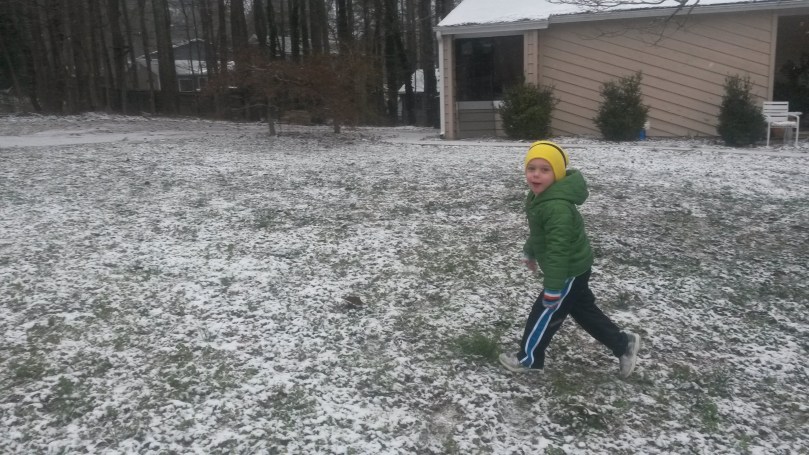
Then again, every now and then, it even snows in Atlanta…
20160123_093316.jpg

This weekly remotivational post is part of Stream of Consciousness Saturday. Every weekend, I use Linda G. Hill’s prompt to refocus my efforts and evaluate my process, sometimes with productive results.
I’m an Atheist


In the spirit of my post yesterday — What Are We Waiting For? — it occurred to me that I’ve actually been sitting on something for quite a while, just waiting for the right time to say it. But as I pointed out in that post, there is no right time. Waiting around is worthless, it only means more of my time lost hiding something that deserves to be out in the open.

Let’s not bury the lede. I’m an atheist. That may not come as a shock to you if you’re a regular reader: I’ve never come out and said it, but I’m sure it’s bled out around the edges from time to time. But I’m an atheist, and I’m damned proud of it.

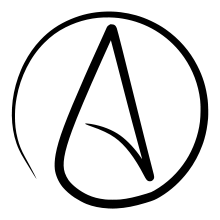
Atheist Symbol

This is a weird thing to sit down and type out, not because it’s something I feel guilty about in any way, but because I fear it might make things weird for me. I live in the southern United States, for one — better known as the Bible Belt. I teach at a school where many if not most of my colleagues are outspokenly religious. My family, while they don’t attend services anymore, brought me and my siblings up in the church. (And I don’t think that reading this will surprise them, but that speaks to the weirdness of all this — we’ve never had a conversation about it.) I’ve got sisters and cousins and aunts and uncles and grandparents and a veritable host of in-laws who believe. Add to that that in recent studies, atheists are the most feared and distrusted of all subgroups of people (even more than Muslims!), and it’s no great surprise that I feel a little bit uneasy on the topic.

Let’s be clear. I’m not here to proselytize. (Though the idea of a proselytizing atheist does give me a chuckle.) I’m not what some might call a militant atheist. I know and accept that the vast majority of people aren’t going to have their minds changed by anything I have to say. And if you do believe, I still welcome you as a reader.

I’m just here to say that in the past, there have been things I was afraid to say for fear of offending another’s point of view. There have been things I haven’t said for fear of making others uncomfortable. There have been things I’ve done strictly to assuage other people’s beliefs.

More and more, though, I realize that while I’m trying like mad to respect other people’s beliefs, I am marginalizing my own. While I’m working to make sure I don’t make others uncomfortable, I’m twisting myself up into knots, or worse, just sitting there like a lump, saying nothing.

No more.

Atheism is the next great coming out. And I am proud to list myself among its members.

I’m here to say that I won’t be hiding this particular aspect of who I am anymore. I’m not going to shove it down your throats, either, but it’s too much a part of me to keep it locked up in a closet. It informs my moral decisions, it informs my interactions with the world, and it damn sure informs my thinking and my writing.

So, yeah.

I’m an atheist.

I just wanted you to know.

The Weekly Re-Motivator: What Are We Waiting For?


What are we waiting for?

Seriously, every one of us has something in their lives that they are putting off. (Apparently the previous sentence is now grammatically correct; thank you, singular-third-person-they.) Whether it’s fear or doubt or uncertainty or perceived lack of ability, we have numerous and convincing excuses for not doing this thing. Those excuses, with the rare exception, are bullshit.

(The above is an absolutely terrible music video for a pretty on-point song.)

Your new year’s resolutions are in all likelihood floating face down in the kiddie pool by now. Forget about that. What’s the thing you really want to do, but haven’t yet? The thing you’re waiting for the right time to do? The thing that, if you had a little more time in your day, you could fit it in? The thing that terrifies you and entices you at the same time?

Sam Harris is responsible for a relevant quote:

Don’t you know that there’s going to come a day when you’ll be sick, or someone close to you will die, and you will look back on the kinds of things that captured your attention, and you’ll think ‘What was I doing?’. You know this, and yet if you’re like most people, you’ll spend most of your time in life tacitly presuming you’ll live forever. Like, watching a bad movie for the fourth time, or bickering with your spouse. These things only make sense in light of eternity.

The fact — and we know it, of course, even if we pretend we don’t — is that we don’t get that much time. Yet we sit around, not doing the things that we won’t admit really matter to us.

So what are you waiting for?

(Stop waiting.)

This weekly remotivational post is part of Stream of Consciousness Saturday. Every weekend, I use Linda G. Hill’s prompt to refocus my efforts and evaluate my process, sometimes with productive results.

The Weekly Re-Motivator: Die Hard


So the prompt for the week is “movie titles”, and the movie that’s front-of-mind right now is Die Hard. (Actually, who am I kidding; the movie is Star Wars VII, but I’ve talked that one to death around here of late… even I kinda want to lightsaber my own face if I bring it up at the moment.)

So, Die Hard. I hadn’t seen it until about a week ago.

I know. I know. I’m sorry. How I was ever carrying a man card before that, I don’t know. But it’s been remedied. Movie seen. Balance in the universe restored.

But my weekly re-motivator is about writing, right? So how is Die Hard about writing?

Maybe the better question is: how is it not?

McClane faces an impossible task: take down a squad of international terrorists. The writer faces many: stare down and overcome the impossibly intimidating blank page, stay focused and driven enough to finish his projects, and eventually, swim out into the open waters chummed with the manuscripts of his fallen comrades.

McClane is hamstrung (literally by his bare, and eventually, his ruined feet; metaphorically by an inept police chief and FBI agents who only make the situation worse), having to overcome obstacles that a normal person in his situation really shouldn’t have to. So, too, the writer: he must conquer his usually over-inflated sense of self-doubt about his abilities, his lingering and ever-present fear of rejection, even his lack of simple time in the day to do the thing he wants to do.

McClane is actually not trying to save the day for everybody; he’s trying to save his wife. (Disclosure: I’ve only seen the first two movies. I know. I’m working on it.) The thing everybody thinks he’s doing — defeating the terrorists, saving the civilians, foiling international intrigues — is secondary to the immediate need to save something that matters to him. Writers? I’ll posit that people think anybody trying to write is trying to become the next J.K. Rowling or whoever wrote Fifty Shades of Grey (shudder). In reality, though? Basically every writer I’ve come across — myself included — is a person who feels he must tell stories; who needs the creative outlet and the meditative focus that writing can bring like he needs oxygen. Not that we would eschew widespread acclaim (nor would McClane turn up his nose at saving buildings and planes full of people), but it’s not necessarily the primary goal.

And then, of course, just like action movies, writing is a thing best punctuated by the occasional bout of gratuitous explosions.

Nah, that’s not a metaphor; that one’s delightfully literal. Because every writer is a little bit of an action hero in his own mind, I think. John McClane saves the day because it’s just what he does. Writers write because that’s just what they do.

Write Hard.

This weekly remotivational post is part of Stream of Consciousness Saturday. Every weekend, I use Linda G. Hill’s prompt to refocus my efforts and evaluate my process, sometimes with productive results.

Flawed Instrumentation: First Thoughts on a Late Edit


I’m starting another round of edits on my novel, and the pain just comes washing in.

With early edits, that pain was the raw, gnarly hurt of recognizing that I’d written a broken thing; a creature whose own limbs would pull it off balance if ever it tried to walk. The narrative was fragmented. Timelines didn’t add up. Characters would vanish for no apparent reason and reappear just as suddenly with no explanation. Look, no writer sits down and creates a perfect story out of nothingness in an afternoon. (Though, somehow, that’s certainly a misconception I’ve held, and I imagine others do too — that the greats just sit down and pour unicorns and fairy dust out of their heads and onto the page, and send it off for immediate publication.) But it’s a hard pill to swallow when you look at your own work and it’s so … let’s not say bad, let’s say, in need of improvement, the way a trauma victim with a sucking chest wound is in need of improvement.

With the latest edit, though, I’m feeling a different kind of pain. Not so much anymore the pain of oh god, what is this monstrosity I’ve created, but more the sharp sting of disappointment. That feeling you get when your kid tells you they did fingerpainting in kindergarten: you expect to see a painting that’s a little blotchy but still a reasonable facsimile of a house or a fish or a dog or a person, but in actuality all you get is a sad, mottled smear. It’s like, yes, you created something and that’s fantastic and adorable and isn’t it wonderful but at the same time, wow, I mean WOW, it’s obvious that you have no talent whatsoever. (Don’t lie and say you haven’t had that thought about your kid’s artwork. The only shining light is that he’s never done anything before, so he was basically guaranteed to suck … you were just holding out hope that maybe your kid was special but surprise, he isn’t!)

I’m about twenty pages in, and my fingers are aching from squeezing the pliers on all the rotted teeth; the blowtorch is sputtering, running out of fuel from searing off all the calamitous verbosity. (Calamitous Verbosity is totally the name of my new band.) I’m reading along and … man, I think the story’s good, but it’s just so cumbersome. So much junk language. So many rambling, do-nothing sentences. So much that’s vague or obvious filler or even worse, a ham-fisted attempt to sound poetic or clever or profound, like an NFL linebacker trying to dance in Swan Lake. It’s like, I can see what you’re going for there, but … no.

What freaks me out is that I already did a polishing pass at the end of my last edit. I read all this over several months back, thought, yep, that sounds like I want it to sound, and stamped it for approval. So now, I’m faced not with the regular, looming specter of self doubt that goes along with all writing, but with the deeper, insidious doubt of wondering whether I ever doubted myself enough in the first place. I once thought this thing was good, and I can now see it was not.

wpid-scragz.jpg

That’s a harsh pill to swallow. I feel like I’m flying in an airplane, and I can look out the window and clearly see the ground a few hundred feet below, but all the instrumentation is telling me I’m thousands of feet up.

Two ways, then, to look at this situation, I think:

  1. My instrumentation is flawed and not to be trusted, ever.
  2. My instrumentation is flawed but improving.

Maybe I got a bad reading before, but I’ve got a better reading now. Maybe when I did those first edits, I hadn’t allowed enough time to pass to get a real, solid, objective look at the thing.

Or, maybe (how dare I even dare to think it) I’ve gotten better in the interim, and I legitimately am looking back at the admittedly inferior work of a fledgling writer, having learned a few things, having a little bit stronger sensibility.

Or, further maybe still, maybe the thing really is just a steaming pile of sharknado.

Difficult to say at this point.