The Weekly Re-Motivator: Nothing Halfway


There’s a mantra I regularly preach, scream, whisper, write, and otherwise fling at my soccer team: Nothing Easy. I’m sure it’s not original to me, though I can’t say I got it from anybody outside of my own skull. I like it — and I encourage my players to repeat it, internalize it, live it — because it can be taken several ways and it works several different ways.

First, the external: the other team wants the victory just as badly as you do. They owe you nothing, and they’ll give you nothing, so don’t make it easy for them. Control the ball so you don’t give them any easy turnovers. Get good position so you don’t give them any easy passes. Mesh on defense so you don’t concede any easy shots. Nothing easy.

Then, the internal: in soccer, more often than a lot of players would like to admit, speed beats talent. Hustle and hunger beats technical know-how. You might have the best touch, the most precise passes, the most devastating shot, but if you can’t beat the other man to the ball, all that skill goes for a big fat goose egg. So, you have to play hard from the opening whistle. Fight for every ball. Run on every play like it’s the one they’re going to break away and score on. Nothing easy.

Point is, if you play easy — if you give the match a halfway effort — you’re giving the opposition an advantage in every phase of the game. Which means, you’re putting victory that much farther away (if not entirely out of reach).

Well, soccer season is almost over, and I’m sitting here really analyzing my writing process, because I’m in a transitional time. I’m almost done with the final (for now) edit of the novel, which means it’s time to start considering what I’m going to dedicate my writing time to next. That means setting new goals, planning a schedule, determining how I’m going to approach the project.

In all this analysis, I realized that, among other things I haven’t been doing in my writing of late was writing short fiction — those 1000-word-or-so stories that I was pretty religious about posting for a long time, those little pressure-release valves for the creative energies I was bottling up while I worked within the confines of the overarching Project. So last night I embraced the prompt and wrote one. And I’ll admit — it may not have been my best work, but what was different about it — what worked about it — was the approach. I didn’t fine-tune the idea to death. I didn’t plot it out meticulously before I put keys to board. I didn’t sit back and wait for it to be perfect before taking my shot (much like the protagonist in the tale). I leaned into the uncertainty and I wrote it full-steam ahead.

I haven’t written like that in a while. I’ve tried out some new approaches (and liked them a lot, to be fair!), honed my craft, become a bit more exacting in terms of how I build stories. But what I realized is, that approach has me operating at half capacity. Throwing myself halfway into the work, keeping one foot on the edge of the pool as I dunk my toes in and test the water. It keeps me from making as many mistakes along the way, but it also keeps me so focused on the road that I forget to enjoy the view along the way.

Like my soccer team working easy in a match, making things easy for the opposition, I’m working halfway and making it easy to get distracted, easy not to finish, easy to pretend I’m working when really I’m just hiding behind excuses.

Now, the only absolute is that there are no absolutes. I’m not going to say that there’s not a time for the methodical, measured, relaxed, easy approach. Sometimes if you rush the work, you make foolish errors that cost you. But if you embrace the easy approach too much — if you work halfway all the time — well, first of all you never get anything done, and second, you don’t make the mistakes that make the work interesting.

When it comes to writing, you have to throw yourself into it the way you’d run out into the road after your kid. You have to give yourself over to it like jumping out of a plane. You can’t keep one foot on solid ground while you let the other foot acclimate. You can’t do it halfway.

Combat Diver, Special Forces, Sonderkommando, Frogmen

So the mantra for my writing — for a while, at least, until I think of a new one — is: Nothing Halfway.

This weekly remotivational post is part of Stream of Consciousness Saturday. Every weekend, I use Linda G. Hill’s prompt to refocus my efforts and evaluate my process, sometimes with productive results.

The Weekly Re-Motivator: Humans Being


I’ve just finished reading Christopher McDougall’s latest offering, Natural Born Heroes. (Review forthcoming.) The central tenet is: you can’t always tell a hero just by looking at him. The strongest fighter? The girl who can outrun everybody in the field? The guy who can traverse a forbidding mountain range in the dead of night on nothing to eat but weeds and acorns? They don’t look like much. They become who they are and capable of what they can do out of necessity, innovation, or sheer bloody-mindedness.

You can’t build resolve like that. You can’t engineer ingenuity. You don’t unlock the secrets of human potential on a whim or by mistake. These things only happen when we eschew the trappings of the modern world, when we cut through the nonsense of our capitalist culture, when we tap into what makes us who we are, what we evolved to do.

Which is, to survive.

Girl, At Night, Running, Cloud, Silhouette, Freedom

But it’s more than that, more than just being. We are human beings, but it isn’t being that makes us human; it’s our doings.

Each of us has within ourselves vast, untapped reservoirs of potential and energy. Everybody knows (or at least suspects) that they could do this or that unbelievable thing. (I could write the next great novel. I could run a marathon. I could quit my job and go herd goats. I could go and ask that girl/guy out.) But most of us don’t do those things. We allow them to remain unbelievable and go on just surviving. Which is easy! But it doesn’t put our names in the history books.

So let me stop myself before I get carried away on a tidal wave of my own ego. I’m not saying my name is going into the history books thanks to anything you might read around here. But there’s a slew of sayings on this particular subject:

You miss one hundred percent of the shots you don’t take.

You can’t hit a home run without swinging the bat.

You can’t hit a target that isn’t there.

Darts, Dart Board, Bull'S Eye, Game, Playing, Target

And with that in mind, this is me taking this opportunity to remind myself that this blarg, this past two years of writing novels and letting the voices in my head take the reins and spill over onto the page, of exploring the vast uncharted recesses of my storyteller brain, is me trying to tap into my inner hero.

Did I actually say that? Yeah, sure. Storytellers are heroes of a sort. We connect through stories. We live expansive alternate lives through stories. We learn to appreciate others through stories. And at their core, stories tell us about who we are.

We can be heroes.

We just have to take that chance on ourselves.

This weekly remotivational post is part of Stream of Consciousness Saturday. Every weekend, I use Linda G. Hill’s prompt to refocus my efforts and evaluate my process, sometimes with productive results.
Lucky Bastard, or A Glitch in the Matrix


No re-motivator this week, because holy carp am I tapped out. Long week at school. Long week at the novel-writing game. Wife is hella sick. No time to muse on creativity and motivation and inspiration and the darkly wonderful things that happen in the writer’s lizard brain.

But, dude. You guys. GUYS.

I am thirty-something years old, and I have never in my life found a four-leaf clover. And there were times that I looked. I can distinctly remember a younger, high-school aged or maybe even collegiate version of myself spending entire minutes in weedy fields searching for one.

Never happened.

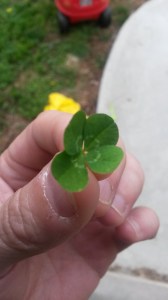
Then, today, this:20160326_185018.jpg

That’s totally my hand; you can tell by the horrible cuticles. I was gobsmacked. We hopped out of the car after a long day visiting with family, and I happened to glance down at my feet, and there it was.

But wait. WAIT.

Not even an hour later, I’d been to the grocery store and come back, and I was reflecting on how strange it was that I should find a four-leaf cloverin my own front yard. I glanced at my feet as I stepped over a totally different patch of clover. And I glanced again.

NO WAY.

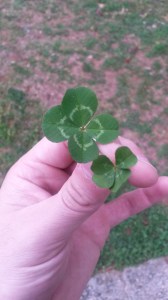
20160326_193643.jpg

But yes way. A second four-leaf clover.

You guys.

Either I’m really, really lucky, or my front yard is a glitch in the matrix.

*skitters off to wait for Morpheus to unplug me*

This weekly remotivational post is part of Stream of Consciousness Saturday. Every weekend, I use Linda G. Hill’s prompt to refocus my efforts and evaluate my process, sometimes with productive results.
The Spring Slump (Do Your Homework)


Spring is that time of year when teachers really feel like they’re spinning.

Spring break is in sight, and beyond it, the shimmering oasis of summer vacation. The long slog through the school year has taken its toll, and we either embrace or evade the exhaustion that it brings; either way, a payment is due, and that payment will be settled in extra sleep or extra stress or extra drinking or extra crying. Or extra all of the above.

Of course, the students see the same oases that the teachers do, but without any of the adult grasp of importance of finishing what you start, or long-term goals vs short-term happiness, or simple good sense. So the kids start to lose their minds a little bit, they start to embrace the summertime laziness a little early, they start to really just kind of get on your nerves.

Teaching is one of those jobs in which the working year starts off hard and only gets harder, as we have to find ways to keep students motivated while their internal motivation is circling the drain. Or, just as likely, we have to deal with a cascade of students who are suddenly failing and can’t grasp why. And of course, behind the tidal wave of suddenly incapable students is the even bigger, louder wave of parents who don’t want to believe that Johnny hasn’t turned in any homework for over a month.

It’s a tough time of year for teachers. I get a little jaded. From the start of the semester I preach and preach to my students — to my high school seniors, even! — the importance of laying solid foundations NOW. Setting good study habits, doing the reading and the writing on schedule, getting the grades of which they are capable on the front end so as to establish good momentum to carry them through the year, to insulate themselves against the senioritis which inevitably creeps in around this time of year.

And yet. It is March, and I find myself preaching again, this time that for those of them who do not see the grade they want, the time to work to fix it is NOW. The time to repair the damage is NOW, before the leaks flood the hold and become irreversible. And the next day I look out into the classroom and I see the tops of heads, their eyes aimed at their cell phones instead of the text of Macbeth. I hear them talking about whatever the kids talking about these days instead of their thematic analyses. I see them putting their heads down and sleeping in class instead of even simply trying to passively absorb anything going on in the classroom.

Soon it will be April, and their 68s will have turned into 62s and 57s, and I will rail again that grades can be recovered and redeemed, but only if they take action NOW, only if they stop the bleeding, cauterize the wound, infuse some initiative, and work to save themselves. And still, I will sit in my classroom alone at 7:30 in the morning, ready and on-call to offer them the help and the time to save themselves, but as useless and unappreciated as a street magician.

And then it will be May.

And they will flock to me like seagulls on an unattended Big Mac.

What can I do to bring my grade up?

Can you give me some points for this?

Oh, you wanted me to turn that in?

Is there any extra credit?

And that’s when teachers begin to have aneurysms.

Every year, I feel like the blind man who sees the future and tries to warn the city of the impending disaster, and who gets ridiculed for his trouble … until the volcano erupts. Of course, by the time the volcano erupts, I will be lounging on Tybee Island and drinking a very cold, very alcoholic beverage.

Cocktail, Tropical, Beverage, Drink, Glass, Summer

If you are a parent and you have a kid in school (and I mean, from elementary all the way up to college, to be frank), this is the time to watch them extra closely. Teachers can only push so hard; kids need the push from mom and dad too.

If you’re a student reading this, know that the number one determining factor in your success is yourself. Mom and dad and your teachers can push all they want, but if you don’t care about your grades (or, gasp, the things you’re learning in class), none of that will matter.

Didn’t mean to end up preaching.

Not that I’m much of a preacher.

It’ll be all right. God never gives us more than we can handle. Because God doesn’t exist. He can’t give us anything. Whatever life has given us, we can handle it. When we can no longer handle it, we die.

…Man, that took a dark turn.

Here’s a picture of a bunny to cheer things up. It’s topical, too, because of Easter … because rabbits who deliver chocolate eggs totally have something to do with this … holiday? … can you even call it a holiday since it happens on a Sunday?

Whatever. BUNNIES!

European Rabbits, Bunnies, Grass, Wildlife, Nature

The Weekly Re-Motivator: Damn These Eggs!


Is there a better metaphor for a writer’s head than a basket full of eggs?

Basket, Egg, Quail Eggs, Natural Product, Small Eggs

You have all these ideas rattling around up there. Poorly formed, fragile little things, each one the seed of something incredible and amazing; each one the proto-soup that can — through a process indistinguishable from literal magic — turn into either a living, breathing, existing thing or your overcooked, barely-edible breakfast.

Consider.

The chicken squirts the egg into the world, full of goop and the building blocks of a fuzzy little baby chick, something it in no way resembles. This is your story at first conception: a seedling, a possibility, an otherwise inert lump of fats and possibilities.

Then it goes into incubation: the mother cares for the egg, shields it from harm and from the elements, warms it with the heat of her own body. So, too, must you protect your fledgling idea. A stiff breeze can scatter it like ash, a judgmental word from a friend can shatter it to pieces (that would never work!), and even your own self-doubt can cause the hapless critter to wither and die (I just don’t have the time, I don’t know how it would work, It’s too big/stupid/much-like-this-other-thing/cliche). It needs nurturing. It needs shelter. It needs to live in the secret heart of the writer for a while before it comes to light.

But one day, the incubation is over, the alchemy of life has worked its magic on the bundle of plasma and protein, and the egg begins to jolt. To judder. The chick within stretches and grows and pushes outward against the walls of its prison — walls it has outgrown — and goes casting for daylight. And it succeeds! First the beak comes thrusting through, then the whole head, and soon it’s nothing but wings and feet and feathers, and hey holy carp, the little monster is walking on its own. That moment comes with the story too: one day it can hardly abide the sunlight and your own doubts about it, the next it’s got legs of its own and it’s not only walking without support, it’s running in its race to be told, and it’s all you can do to keep up with it. Sure, it still stumbles, and sure, its wings aren’t fully-formed enough to fly, its feathers not developed enough to insulate it. But it’s alive, and there’s no stopping it.

Chicks, Babies, Black, Beige, Animal, Domestic, Chicken

With time, it grows; it learns to walk without stumbling, it learns how and where to find food, it even learns to fly (awkwardly) a little bit at a time. This, too, is your story: the longer you work with it, the more you get a feel for what works, the more it feels like the story is doing much of its own heavy lifting. It tells you when things aren’t right. It can solve problems for itself if you let it.

And eventually, that little baby chick gets to the point where she can have eggs of her own, and the whole process begins anew. And just like that, your own story will spawn ideas of its own; ideas related not just to the squawking, squalling storyworld it lives in, but worlds unto themselves, ideas to be incubated and saved for another time, another place.

But what if your idea isn’t meant to be a chicken? Well, some ideas aren’t cut out for it. And those ideas are food. Crack them open, extract the useful bits, stir them into a bowl with some other stories, cook off what results, and see if any of it is edible. Because an egg — or an idea — that goes unhatched and uncooked will pretty soon start to stink up the joint.

Egg, Eggshell, Broken, Yolk, Shell, Yellow, Egg Beater

And now, just because I enjoyed it last week, a list of egg-related writing metaphors.

If you want to make an omelet, you’ve got to break some eggs. Applies for characters in the story — sometimes you’ve just got to kill one or erase him completely — as well as ideas you thought were awesome at the beginning and that have turned into dog vomit along the way. Let ’em go.

Don’t put all your eggs in one basket. Commit too fully to one idea — or even to one aspect of an idea — and you will inevitably be disappointed, because it doesn’t always work, and it definitely doesn’t always work out the way you expect.

Walking on eggshells. Sometimes you proceed with reckless abandon, sometimes you have to slow down and measure every step. Nothing wrong with this every now and then, as long as you don’t write the whole story like that.


And finally, my favorite egg-related moment in literature. From A Raisin in the Sun, by Lorraine Hansberry:

Ruth: How do you want your eggs?

Walter: Any way but scrambled.

Ruth: (Scrambles eggs.)

And later in that scene:

Walter: Man say to his woman: I got me a dream. Woman say: eat your eggs. Man say: I got to take hold of this here world, baby! Woman say: eat your eggs and go to work. Man say: I got to change my life, I’m choking to death, baby! And his woman say: your eggs is getting cold.

A lovely snapshot of the dreamer against the pragmatist.

How else is an idea like an egg? Let me know in the comments!

This weekly remotivational post is part of Stream of Consciousness Saturday. Every weekend, I use Linda G. Hill’s prompt to refocus my efforts and evaluate my process, sometimes with productive results.