You Can Always Start Again


How many times can I do this?

Abandon this site, forget it even exists, come back to it, think “gosh, I should really write something,” write a few sentences, hate it, hate myself, abandon it, abandon any hope of writing, abandon all hope, dissociate, hate myself for THAT, at some point feel the tickle in the back of the brain that signifies an idea wanting to be written, rinse, repeat.

I’ve even written, and abandoned, THIS VERY POST more than once over the years. Hell, I may have actually posted this post before, but if I did it’s far away enough in memory that it might as well have been written by somebody else. A different guy, hating himself, feeling something like inspiration again, feeling guilt over neglecting his practice for so long, vowing to come back to it, or at least not to forget about it for a while, only to forget about it again.

It’s happened enough that I’ve thought more than once about discontinuing the site. Feels like a monument to another life, a guy I can’t be anymore. I think back to the early days of this place, about a guy who was somehow teaching full time, and writing something like 2000 words every day — 1000 words or so in a novel and just about that much again on this site about any damned old thing. Good or not, insightful or not, tortured and faux-poetic as it may have been, it came out.
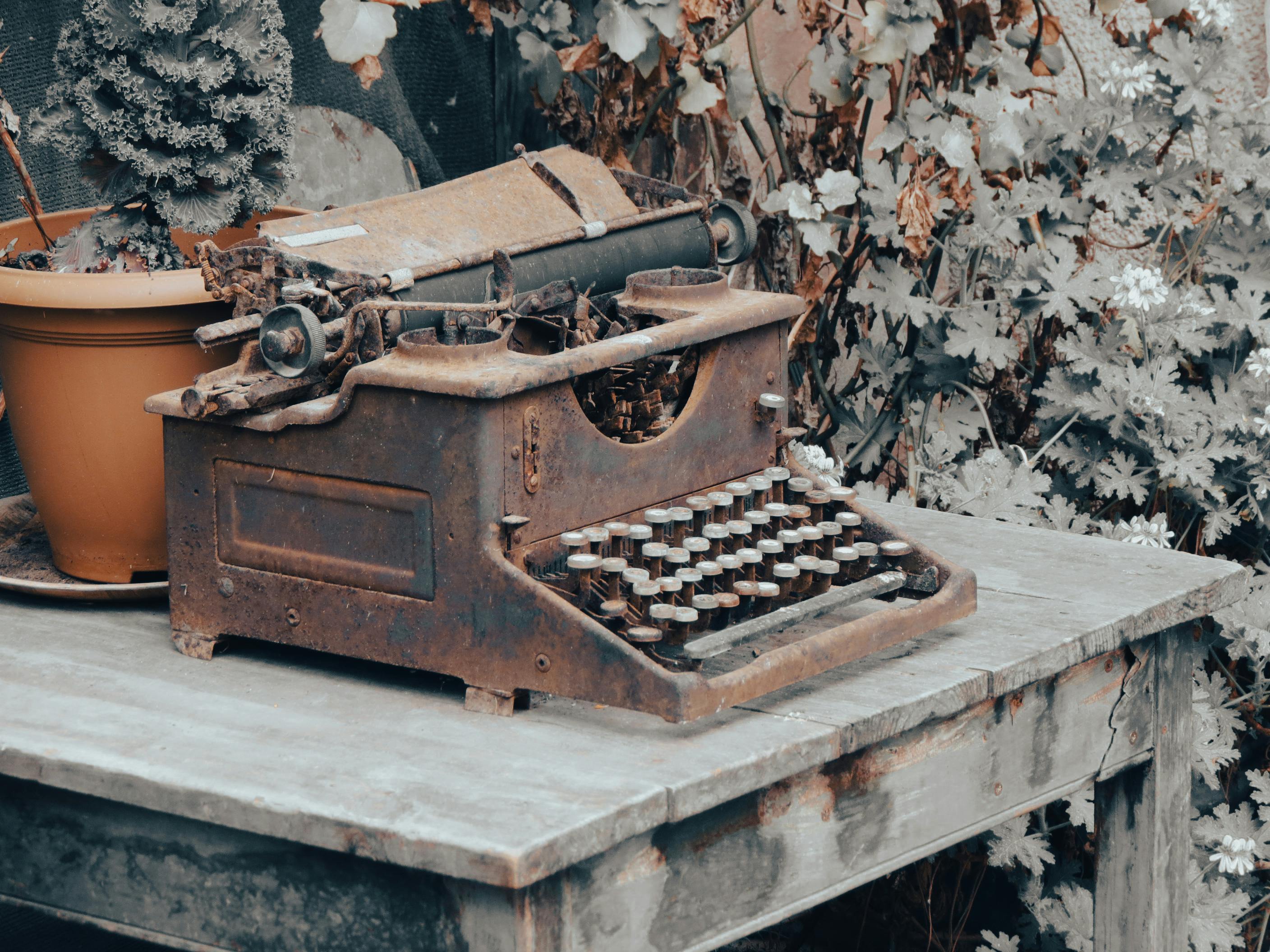
A dusty, rusted typewriter on a desk, also derelict.
Actual photo of my writing habit.

And every re-attempt to get back to that, or something like it, has only made me feel bad. I feel like I’m living in that guy’s shadow. I was feeling it then, I knew what I was doing, or even if I didn’t know what I was doing, I could fake it.

I read a book recently. (I know, I know. Foolish to think I’m getting my life — my writing life or any other kind of life — back on track just from reading a book.) (Also, second sidebar — I guess I haven’t lost THAT particular peccadillo — I didn’t technically READ it so much as I LISTENED to it over a couple of my regular 3-hour sojourns to visit with my wife and daughter in this crazy, de-tuned and de-synced year I’m living. But that counts, and I think my experience with the book may have been better for it. More on this in a moment.) The book was “Big Magic,” by Elizabeth Gilbert. She, the author of “Eat, Pray, Love.” (I know, ok? I KNOW.) In it, Gilbert talks a lot about the artistic life — yes, often the writer’s life, but the artistic life in all its forms: dancers and figure skaters and painters and screenwriters and travelers and teachers and creators of all stripes — and advocates a frankly wholesome view on the act of making art. And it’s like…

Ok, so I don’t have the greatest memory, yeah? Put that down to the long years drinking or, y’know, experiments with other things, or (god it hurts to say it but I can’t pretend otherwise) old age, but also bear in mind the fact that I have never in my life been particularly good at remembering things that are actually important (yet my head remains rife with useless movie quotes, fantasy novel trivia, and knowledge of my favorite old video games). So a thing I’ve started doing in the last couple years is taking notes. Digitally. I use Obsidian for this, and I might write about it sometime, but the point is, when I come across something I think might be important, and when I, y’know, REMEMBER TO DO SO, I make a note so I can find the important information again. I particularly take notes on books, because 1) I love reading, 2) I never remember what I read except in broad strokes, and 3) reading is time-consuming, so I would rather not spend my time re-reading books over and over just because I vaguely remembered they were good. So: when I read a book, I do it with pen, highlighter, or dog-eared-pages in hand, and when I get to the end, I note my thoughts on the book, pull out my favorite quotes, and catalog it. There’s a satisfaction to this process that’s hard to quantify, but needless to say, this method is best with a book I can mark up. Audiobooks, I can’t highlight or underline a passage. I can bookmark a moment, if I can be bothered to futz with the phone at the moment, which usually I can’t, because I was listening to the audiobook in the first place so that I could be focusing my hands on DRIVING or washing dishes or swing while I’m on a run or whatever else.

Ok, that was a long way to walk to tell you that Big Magic was a book that, had I been properly reading it, would have gotten a hell of a lot of markups and dog-eared pages, but because I listened to it, I had to sort of let it wash over me. Like lying on the beach as the tide comes in. Little by little, broken up by stretches where I would space out or get distracted, Gilbert’s observations just sort of lapped at my edges in her calm, reassuring tone, and after about six hours of driving, I realized something weird.

I wasn’t hating myself about the abandonment of my art.

This was a wholly unique feeling. I’d gotten so used to the low-simmering disappointment with myself over drifting away from this craft that to not feel it was a little like the first time I shaved my head and stepped outside on a windy day. What a refreshing absence.

Suffice to say, much of the book resonated with me, and maybe I can find more to say about it sometime. For now it’s enough to say that I wanted to return to the site here, not out of a sense that I *had* to, or that I needed to try to *recapture* what it once was, or to do so with any sort of goal in mind at all. I could’ve started a new one, but I figure, for better or worse, that this, too — even this sporadic period of barely anything over the past several years — is a part of the journey that this website is all about. And maybe I’ll turn it into a regular practice, and maybe I won’t. Tonight, at least, it feels nice to let my fingers dance on the keys, to spray these words onto the void of the blank page, to not worry about WHAT IT MEANS or whether it’s THE START OF SOMETHING NEW or whether it MEASURES UP TO WHAT I USED TO DO. Comparison is the thief of joy, etc, etc.

Tonight, at least, it feels good to open the spigot on my brain and let the thoughts drip out.

Tonight, at least, I’m here.

But…

There’s something else, too.

In “Big Magic,” one of the things that clicked with me was when Gilbert said you should treat your art like a new relationship. You spend your time thinking about it. You keep it secret from people, because you’re not sure about it yet. You sneak away to send it a quick message — to get a few more words down.

I may have (perhaps foolishly) started on a new project. I’ve written two and a half scenes so far, and y’know, it’s fun. I don’t know if it works yet, or if I’ll like it even if it grows up into a full-fledged thing, but I can fall off that bridge when I get to it.

But that’s not the thing. The thing is: I told my wife about it. Sheepishly. Ashamedly. Too early, to be sure. The concept is barely formed, the clay still damp and lumpy. “It’s probably dumb,” I think I said. “I dunno if I can do it,” I KNOW I said. “But I’m gonna try it.”

“Really?” She said, with something like a smile.

“Yeah, but who knows if I’ll finish it.”

She thought for a second. “I like it when you write.”

At least, I think that’s what she might have said. As I mentioned above, I don’t remember things so well. (My hearing isn’t great either, while we’re on the subject.) It’s possible she said “I like you when you write.” Or maybe it was just “I like when you write.”

Thing is: I also like when I write.

I forget that too often and too easily. If nothing else, I’m going to try to remember THAT.

Bend One Over For Me


My wife is a librarian.

She’s a lot smarter than I am, as I may have mentioned before. Which probably explains why she had a career, first in the news (where she wrote the words you’d see on your trusted news sites — and sometimes coming out of the anchors’ mouths), and second in the school system, facilitating students’ access to the carefully chosen words of thousands of authors and information sources.

She’s an expert, is what I’m trying to say, on the written word. And I’m, you know, working on that. Needless to say, our house is full (yeah, probably overly full) of books. We keep books everywhere: the bedside table, the downstairs library, the shelf in the living room, the cubby in the kitchen, our children’s bedrooms, our personal spaces at work, our bags going to and from work. I even keep books in my car, and I’ve been known to sneak a page in at that one reeeally long traffic light. We give books as gifts to each other and to others. We know books, we love books.

But one thing you’ll find in my books that you won’t find in hers? Dog-eared pages.


See, I used to re-read books that I enjoyed. I still do that occasionally, but I just don’t have the disposable time that I used to have. There are still, though, those passages in books of all stripes that just hit me — a nasty literary hook to the solar plexus, a wicked narrative cross to the temple — that I know I will want to experience again. I may not have time to go cover-to-cover again, but when I’m jonesing, I can pick up a tome I’ve traveled before and browse the greatest hits.

But how do I find them again?

I have to mark them.

I usually try to keep a pencil quick-to-hand, but especially at home, that isn’t always the case. When I’m neck-deep in a gripping read, the last thing I want to do is put the book down and cross the room. I’m not doing that. Plus, even if I do have a pencil handy, what are the odds I’m going to see my pencil mark as I flip through the pages? Not great. Sure, there are highlighters for such quandaries, but highlighting reminds me too much of school, and this is leisure, not work. So highlighting is out, for me. (Unless we’re talking e-books. Which we’re not. We have some standards around here. [Just kidding. E-books are great. I have lots of them. But you and I both know that there’s nothing like the real thing.])

No, if you really want to find that knockout passage again, you need to mark the whole page so that you can open right to it.

Again, there are methods for such things. Some people, I understand, like post-it notes or little scraps of paper. To that I say, who has the time? If I’m not going to interrupt my read to get a pencil, I’m darn sure not going to go downstairs to the office to get a post-it to stick between the pages. I’m not going to sit here and rip up a piece of paper to make a dozen tiny bookmarks. (Also, they fall out!) Nonsense.

No, what I’m going to do, when I find that lexical 10-point-dive, is I’m going to do what any lazy (read: normal) person would do. I’m going to read it, realize I’ve just had my world rocked, read it again, then reach up to the top of the page and bend that corner over. Bang. Done. I didn’t have to get up, I don’t have to fiddle with other implements, and I’ve created an effortless-to-find mark in the book that will last, at the very least, until I open the book again.

It probably goes without saying (though I am happy to say it anyway) that I have a chosen handful of books so dog-eared that the unbent pages are rarer than their bent brethren. My copy of the Ultimate Hitchhiker’s Guide comes to mind. As does my (and I shake my head a little at this) little pink-covered edition of Zen and the Art of Motorcycle Maintenance. I may not have the time to read them again these days (for the fourth, or the fifth, or the forty-fifth time), but if I need a fix I can crack them open and browse through some of the passages that made me love them.

20180823_083021.jpg
Assuming I can find the passage I was looking for. Heck, I’ll find SOMETHING good on one of those pages.

If not for dog-ears, where would I be? Lost, that’s where.

Which, for my personal collection of Books That I Own, is fine.

But I’ve rediscovered the library, lately. And, oooooooooh, does my wife have a problem with me putting a dog-ear in a library book.

Because if books are sacred (and inasmuch as I hold that nothing is sacred, books may be the closest thing to it), then library books are doubly so. They belong not to one, but to all. They are a shared resource, a tool for the entire community. Bending the pages is damaging them, she says, as surely as is scribbling in the margins, bending the cover back, or dropping them in a puddle. I’m leaving the book in a less-than state for the next reader when I damage it.

And, as far as damage goes? Yes, I totally agree. Library books, by dint of their communal nature, are sacred and should be taken extra care with. (Don’t end a sentence with a preposition, they said. Avoid passive voice, they said. Rules are for breaking.)

But I hold that dog-earing, and even the occasional note in the margins (I wouldn’t write in the margins personally, but I don’t mind finding writing in the margins), is the antithesis of damage. It’s enrichment.

In fact, if I find that a book I’ve just checked out is dog-eared up already? Ooh boy, I know I’m in for a treat. A dog-ear in a book I haven’t read yet is a flashing neon sign, the finger of an unseen deity saying “the stuff you want in this book? It’s right here.” If it’s a nonfiction book, I’m opening right to that page. In fiction, I note that page the way you note the dessert table on your way into a buffet. Can’t wait to get THERE. (Seems like I’m having a food motif of late around here. Couldn’t possibly be the new diet.)

So, naturally, I feel that when I dog-ear the pages of an enjoyable book, I’m returning the favor. Paying it forward. Marking off the trail for the prospective readers yet to come. And if it does benefit the next reader, that’s awesome. But the truth is, I would do it anyway. Dog-earing a book is one of those rare acts which is both selfish and serves the community. I do it for myself, but it might benefit somebody else, too, and I think that’s awesome.

Heck, Kindle — or maybe it’s Google Books, or maybe both — will already identify for you the passages that other readers often highlight in the books you read. Isn’t this basically the same thing?

20180823_082308.jpg
The library-owned copy of “10% Happier” I’m currently working through. Sorry not sorry!

Still, my wife scowls at me when she catches me at it. “How can you do that to a library book?” she demands.

How can you not, I don’t dare say in return.

Except that, uh, the jig will be up when she reads this.

So … yeah.

Am I wrong for this? Or is this not a service we owe to one another?

Don’t Forget Your Library


Writers are supposed to read, right?

And we’re supposed to read widely and prolifically, right?

Here’s the truth: in years past, I haven’t read enough. Not as much as I liked, and certainly not as much as I should. Why? Because books are fraggin’ expensive. And a major commitment. You go and drop forty bucks on a handful of books, not knowing if you’re going to enjoy them. But because you’ve spent the money, you feel obligated to read through the whole thing, whether you’re enjoying it or not.

Now, I’m not saying you shouldn’t be buying books. (As a guy who very much hopes you may buy his books when they become available, that would be pretty much anathema.) But for whatever reason, I had forgotten about the most obvious alternative: the library.

My wife recently started her specialist’s program, and had to do a bit of research. So off she went to the library. And because, you know, libraries are good for kids books, she took the kids along, and I went, too. And so I got a chance to browse around as well. And, hey, here’s a John Scalzi book I’d been thinking about reading — I read Lock In and loved it, but wasn’t sure about his other stuff. And there, some Neil Gaiman — somehow I haven’t read much of his work, but I’ve heard very good things. And then over there in nonfiction, a bunch of titles by Malcolm Gladwell — I’ve been listening to his podcast, and it’s excellent, so why not?

I went home laden with a bunch of titles I wouldn’t have read otherwise, feeling basically no commitment or obligation to any of them. Which is really the best way to read a book — with no expectations.

I read a few, and it was good — but I quickly became a little disillusioned. Our local library is pretty tiny, and the selection isn’t much to speak of. But — what I didn’t know until recently is that basically all the libraries in the state are networked, which means that you can browse the entire selection of books in all the libraries (which is quite a lot.) Then, if some library carries a book that your branch doesn’t, you just put in a request and within a week or so, the book shows up at your library.

This changed everything.

I’ve now got a queue of books ten deep and a stack of five or so on my bedside table. I’m reading books on philosophy and sociology and nuclear weapons and all kinds of things that I just couldn’t pull the trigger on before, for whatever reason. (The fact that it’s summer helps.) You might even say I’m reading so much it’s to the detriment of my writing, but that’s a discussion for another time. (It’s easier to pick up and put down a book at will than it is to pick up and put down your novel.)

Point is, I’m shoving words into my facehole at an unprecedented rate lately, and it’s entirely because I’ve rediscovered the library.

So, you know. Visit yours. Check out a book. Learn something new.

Forgot.


After a really productive, really invigorating session editing the novel today, I turned around and left my reading material at work.

Today was rough. We were up way too late (hooray SUPERCELL STORMS), long day at work. All I wanted was to kick back and read a little. I don’t even read every night. But I really wanted to read tonight.

I NEEDED IT.

TooMuch

I know exactly where I left it. I can picture it, clearly, on my desk. Perched atop a small pile of ungraded papers. Jauntily turned at a thirty degree angle, for ease of picking up and chucking in my bag.

Where it will stay.

Unread.

Blarg.

The Too-Good Book Blues


I’ve just finished reading a book that I’ve had in my “to read” queue for far too long: Paul Tremblay’s Head Full of Ghosts. It came highly recommended from a number of sources, and though I don’t usually read horror novels, I have to say, it’s a hell of a ride. Possession. Fear. Devils and demons. (Maybe? Or maybe not? The book and its main character are kind of agnostic on the point, which is frustrating, but also powerful.) And a blindsiding final twist that doesn’t disappoint.

It’s one of those literally unpotdownable stories that keeps you breathlessly turning the pages.

Which is both a good thing and a bad thing. Good because it fills my head with all sorts of ideas and aspirations in addition to just being a bloody enjoyable waste of time. Bad because it’s over now, and I have to pick up something else to read, and whether the next tome I pick up will even come close is anybody’s guess.

English needs a word for this feeling: that vague hopelessness you feel after tearing through a proper humdinger of a story, that creeping suspicion that what comes next can’t hope to compare. (The Dictionary of Obscure Sorrows should get on that.)

In fact, I think it’s partially this feeling that’s had me so on the ropes creatively lately — in addition to the move, which swelled up and rolled out of control like the Thing and, bloblike, consumed my entire summer, I read John Scalzi’s Lock In at the beginning of the summer and it so filled me with this sensation that I couldn’t get interested in reading anything else for about a month. I pawed at Tremblay’s Disappearance at Devil’s Rock and it just seemed to drag on. I nibbled on Matt Haig’s The Humans, and, though it’s really very entertaining (an alien puts on a human skin to stop a scientific discovery from reaching the light of day), I just kind of stopped reading it for reasons I can’t properly identify. Nothing wrong with the books. They just didn’t exactly seize me by the lapels.

But Head Full of Ghosts did, and now I have to deal with that. The next book up is Michael Crichton’s Micro, which I bought at the bargain bookstore and have put away 150 pages of in just a few nights. Not a bad start.

And, for that matter, look — it’s got me posting on a weekend again. Maybe the haze is lifting.

This post is part of Stream of Consciousness Saturday.