The Mis-Education of the Stanford Rapist (We Are All Teachers)


I didn’t want to write about this Stanford case, mostly because I don’t want to think about it too much. In particular, I don’t want to think about it for two reasons:

  1. It is only by the ludicrous caprice of luck that the women in my life haven’t been touched by the poison of rape or rape culture (that I know of!). A friend of mine on facebook put it rather succinctly (and I’m paraphrasing): It’s like a minefield. Suppose we lined up 100 women at a college or university and started walking across the field. I make it across, but turn around to see that 20 women didn’t make it, and are now lying in pieces across the field. And the truly horrifying thing is that I did nothing different to cross the field than the ones that didn’t make it.
  2. The rapist (and that’s the only way I’ll refer to him here, because that’s what he is) is (apart from the rape I mean) not so very different from guys that I went to school with, if not myself. I mean, I got good grades. I wasn’t athletic, but I was somewhat talented and well-enough liked in my circle of friends. I was a suburban white kid. Not particularly affluent, but I can’t remember wanting for much in my childhood. Point is, I could easily have been friends with someone like the rapist and not known the difference. There, but for the grace of etc…

Unfortunately, as I see the outrage growing across social media, and the poignant and plaintive sentiments arising from the women in my circle, I’m realizing that this problem is bigger than a Stanford rapist. It’s cultural. And because I have a daughter (and a son, for that matter), it’s an issue that’s going to have to be dealt with in my house.

And deal with it we must. There’s something broken in our culture, and by extension, in ourselves. It’s so easy for the rapist’s father to say “this is not the son I raised; he made a mistake.” Regardless of how tone-deaf his letter was (and I want to circle back around to the issue of platforms and how you use them in a later post), his sentiment was basically what the sentiment of any parent would be. Look at the mothers and fathers of criminals of all stripes, and you will see the same statement bubbling up like primordial gas from a primeval swamp: we had no idea. But we have to have an idea. Regardless of intent, the actions of the father and mother (or maybe, their lack of action) played a role in turning their son into a rapist. Just Alyssa had a rather good post about this that’s worth a read. But parents have to know what their kids are doing, and they have to be aware of the impact that their actions will have on their kids. As much as his dad and his friends protest that the rapist is “not that sort of person” and he “just made a mistake,” it’s hard to imagine a perfectly straight-laced kid going straight to sexual assault as a first transgression. This didn’t happen in a vacuum. It’s not just the fault of the rapist.

Another friend of mine wrote about how she came to realize that men were a thing she had to protect herself against, a thing she had to be wary of. And it made me realize that conversations I thought were a very long way off indeed are perhaps not so very far off as I would prefer. Because the time will come when she has to protect herself — hopefully not from an active attacker, but certainly from getting into a situation where a would-be attacker crosses the line from upstanding Stanford student to rapist. And I want her to be prepared when that time comes.

But that’s only half of the equation. In fact, it’s not even half. Because while women are the victims of rape, they are not the source of it. Rape is a male problem with female consequences. Which means that, perhaps even more so than teaching my daughter how to protect herself, I have to teach my son how to treat women so that they don’t have to protect themselves. The Stanford rapist did not become a rapist just because he had a few drinks. He became a rapist because of a lifetime of entitlement and the enabling of parents and peers and an ignoring of warning signs along the way.

In a way, he is, sadly, a victim as well — but not in the way his dad thinks. Not as a promising young man whose future has been ruined by the evils of alcohol and college culture and an unfortunate 20 minutes behind a dumpster. He’s a victim of those people who should have taught him better, should have steered him onto a better path miles and years before he encountered his victim behind a dumpster. He is a victim of his parents and his friends and his culture that trained him to think he was entitled to whatever he wanted and that he would get away with whatever mistakes he made.

We have to educate our young women — but I have no doubt that the victim in this case was educated. No defense is perfect. Even the best-defended fortress will fall under constant attack — and make no mistake, our young women are under constant attack in this day and age. No, far more important than educating our young women is educating our young men. The best defense is a good offense, so they say; and the best defense for our young women is creating a society in which they no longer have to know how to defend themselves.

We have work to do. Parents of young men have work to do. Teachers of young men have work to do. Friends of young men have work to do. Aunts and uncles, big brothers and sisters, employers, pastors, coaches … if there is a young man in your life who has ever looked to you for an answer, you have work to do.

The justice system isn’t going to do it for us. Government isn’t going to do it for us. God certainly isn’t going to do it for us.

If we want this to change — if we really want our young women to be safe — the change starts in our own houses. It starts with us.

Nutritional (?) Content


Sooooo… I’ve been on something of a junior crusade against sugar lately. Maybe it had something to do with the fact that my 4-year old had three cavities filled not to very long ago … meh. Reasons aren’t important. I’m giving labels a little more of a look than I used to.

So he asked for waffles this morning (just now, in fact), and, well, you can’t have waffles without syrup. That’d be like driving to Florida with the windows up and the radio off. But wait — syrup is basically JUST sugar, isn’t it? And because of the sugar junior crusade, I peeked at the label:

20160605_062229.jpg

Problem is, food labels are largely meaningless. Right side: chemicals schmemicals, blah blah blah. High Fructose Corn Syrup is basically the devil’s own heartsblood, yada yada. Whatever. We all eat chemicals, that ain’t my concern (this week).

Sugar: 43 grams. Well, dammit, we’re in America, what’s a gram, anyway? They might as well have said 1/18th the volume of your ear canal. (Herein lies the problem for Americans especially when it comes to this sugar thing: we don’t know what the hell grams are. Turns out the maximum recommended amount of sugar for a grown dude like me is between 40-50 grams. THE MORE YOU KNOW.)

Then, hmm. 210 calories? Sharknado, that’s high, innit? But oh, wait. Serving size: 1/4 cup.

1/4 cup?? Seriously? Who, outside of legitimately handicapped people with no motor control or 4-year-olds out of their parents’ view uses 1/4 cup of syrup for anything?

Ugh. Serving sizes. Grams. Chemicals. This parenting gig … who has the time to look out for everything you’re supposed to look out for?

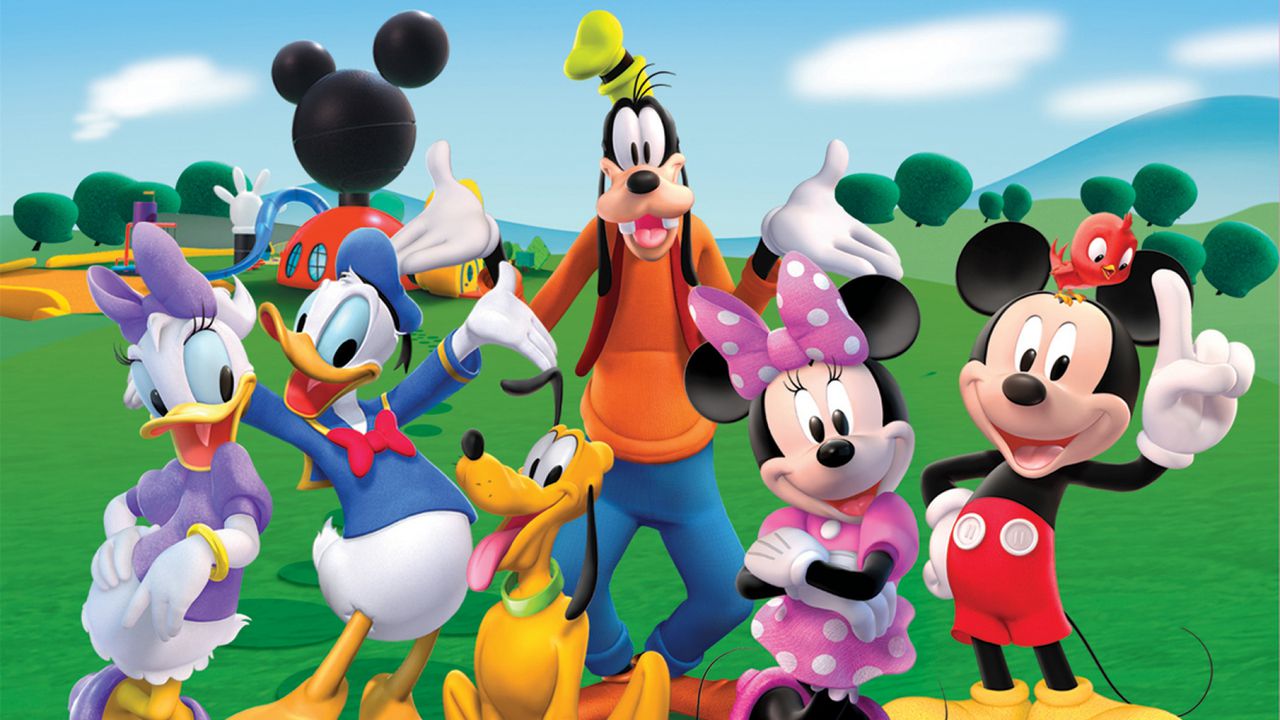
Why Mickey Mouse Clubhouse is the Worst Kids’ Show


Writing is a skill, much like any other. Sure, some of us are gifted in the art more than others, and acquisition of the art comes easier to some than to others. Nonetheless, it is a craft with techniques, maxims, principles and tropes. I like to think that I’m one of those who is to some extent “gifted” as a writer — it’s always come naturally to me and I’ve always enjoyed it — but I can still track my improvements, even markedly so, over the past couple of years. I can see where, when I started out, I was not particularly good at this or that aspect of storytelling, and where and when I learned how to tell my stories better.

But learning is a double-edged sword. When you’re oblivious to things, they don’t bother you; nobody in the dark ages gave a flying sharknado about whether the world revolved around the sun or whether an astronomical turtle carted it around the universe. They didn’t know any better, so they didn’t care. Meanwhile, in contemporary times, B.o.B. can scrap with Neil deGrasse Tyson on twitter over whether the earth is flat, and a fair contingent of people get rather reasonably upset with him. Once the knowledge of a thing is readily available to anybody (i.e., that the earth is round), it becomes your responsibility to know the thing or suffer the consequences (ex., ridicule in the public arena).

All this is to say that, once again, a little bit of knowledge has ruined me. Specifically, it’s made being a parent harder, because I can’t watch Mickey Mouse Clubhouse any more. (For the uninitiated, toddlers run in phases. One TV show, one movie, one character, will hold their focus for months at a time and then, like a fickle spring zephyr, the old stuff is on the garbage heap and it’s on to the new hotness. Well, it’s a Mickey Mouse Clubhouse hurricane season at our house right now, and avoiding it is nigh impossible.)

Sounds like an invented problem, you say. You don’t actually have to watch the shows with your kids, you rightly point out. Better yet, why let your kids watch TV at all? To which I say, “maybe,” “good point,” and “get off your damned high horse.”

But I think the underlying problem I have with this show is a lot more pervasive and insidious than “not liking it.” Rather, this show teaches poisonous lessons about life

So how has knowledge ruined me for this show?

My wife points out that it only takes having a brain to feel numbed by the show, and I’ll agree with that. The problem I have is that I can see the withered heart pumping the oily blood through its crumbling extremities. Which is to say, I know (a few things) about storytelling, so I recognize all the ways the show gives the finger to everything that humans love about stories.

In a nutshell, this is a kids’ show much like any other. A band of sillies get themselves into weird little dilemmas (we lost the magic thing! soandso has to prepare for something! there’s a journey to be taken!) and they solve their problems in a half hour.

Except there’s nothing satisfying in the way they solve problems, because all of their problems are solved by a floating deus ex machina that they call on every time something gets in their way. This deus ex machina is called “Toodles”, and at the outset of every episode, it girds itself with a handful of disparate items designed to help the characters out on their journey.

I feel like I’m not getting the full picture across. What we like about stories is seeing characters put to the test, seeing the unique ways they solve (or fail to solve) their problems, seeing how they grow as a result. But these characters don’t solve their own problems. They don’t bring a unique set of traits to bear on a problem, they don’t worry away at it like hamsters gnawing at corn cobs until a solution presents itself. They hit a barrier, they call on their magic problem solver, and he gives them something that lets them solve the problem immediately. It’s like you were playing Super Mario, and every time you came to a tough group of goombas, an invincibility star dropped out of the sky, or every time there was a tough series of jumps, a handful of platforms would suddenly appear for you to just walk across. Sure, you’d beat the game, but there’d be no point: nothing you did had an effect on the way the game played out.

But this isn’t a hallmark of kids’ shows. I’m not unfairly singling this one out. Blue’s Clues was a favorite around my house when my younger siblings were growing up, and that show works as a storytelling exercise. In every episode, the dog wants something, but the dog can’t talk to tell its master what he wants. So he marks a series of objects around the house with pawprints, and the master (with the help of the viewer) has to put those objects together to figure out what the dog wants. The dog uses its brain to find a way to solve its problem.

Then there’s the more contemporary Animal Mechanicals. My son loves this one, and I can’t stand it, but it still works as a story. You’ve got the usual band of sillies, but in this one, each character has a special ability: there’s the fast one, the stretchy one, the strong one, the one that’s got a swiss army knife implanted in his tail, etc. And those characters cooperate with each other, using their special abilities to overcome their problems.

But who gives a damn? I hear you ask. It’s just a kids’ show.

I’m not saying that kids’ programming should be the epitome of storytelling. But in just the way that a bicycle for a five-year old looks pretty much like an adult bike, just smaller, I think that stories for kids should parallel the stories we tell as adults. I mean, that’s part of why we tell stories, isn’t it — to vicariously experience the world, to teach ourselves ways to be (or ways not to be) and ways to solve problems?

That’s what the core of this rant is about, and that’s what really bugs me about the show. In literature, just like the world we actually walk around in, the world does not solve problems for you. All the world does is dream up more and more exquisite ways to challenge your abilities. But in Mickey Mouse Clubhouse, the storytellers solve all the characters’ problems for them before they even leave home.

Toddler Life, Chapter 338: Picture Day


Being a kid sucks.

I mean, to an adult, being a kid is awesome: you have zero responsibilities, zero stress; all you have to worry about is whether you want mac and cheese or chicken nuggets for dinner, or how many laps you can run around the couch before you get dizzy and fall over, or how many colored scribbles you can get on the wall before your parents have a hissy fit. (The answers, obviously, are chicken nuggets, twenty six, and anywhere from three to a hundred and three, depending on how much you’re laughing like a maniac while you do it.)

But actually being a kid actually sucks.

You’re always getting hauled off to places you don’t care about. Trips to the grocery store or to Target. Stops at the bank. A daily sojourn to day care. Then, you’re being forced to do all sorts of things that interest you not a bit. Eating vegetables. Going to bed at a “reasonable” hour. Not coloring on the walls. (I should confess that both of my kids are actually pretty well-tempered about these things almost all the time.)

But despite these day-to-day inconveniences, I don’t know that, for a kid, there is any indignity worse than picture day.

You wake up, hoping for a day of cartoons and playgrounds, of candy and sunshine, but the parents are up. And they’re a little bit more wound up than usual. Bustling about. Rushing through breakfast. Nipping at each other about time and duties and outfits and responsibilities. Then they’re stuffing you into stiff clothes that — let’s be honest — are a little long in the sleeve or short in the leg: uncomfortable threads that rub and irritate and constrict and ride up.

Next thing you know, you’re crammed into the car seat — but you can’t have any snacks, because you can’t get any gunk on your hands, and you can’t have anything to drink, because you might spill it on yourself. Now you’re sitting around a lobby, and sure, there are toys around, but they’re not great toys, and your parents are getting mad at you for trying to run around and crawl on the seats, and there’s nothing really to do except sit around and not have fun. Anathema for a toddler.

Finally, you’re shepherded into another room with some other lame toys and a weird adult with a fancy camera, poking and prodding at you and telling you where to stand, how to sit, where to prop your knees, and she keeps telling you to “smile” or say “puppies” and all manner of adults-talking-to-kids-they-don’t-know nonsense.

Intolerable.

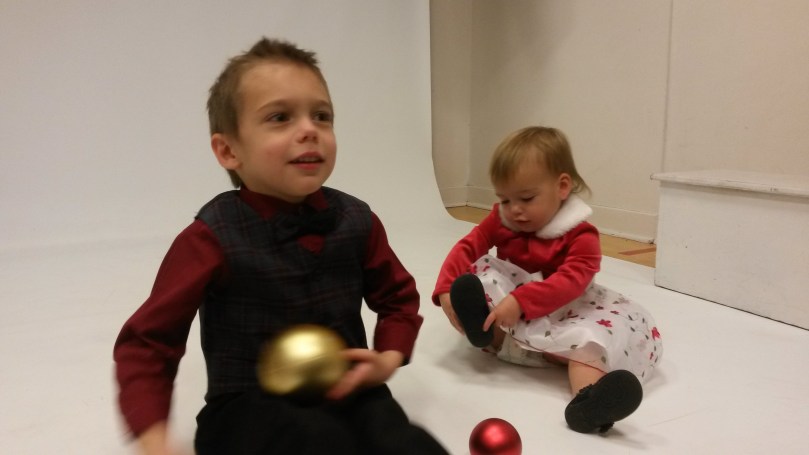
You can bear it for a few minutes because you’re generally agreeable, and your parents seem really concerned about you doing what the other weirdo asks. But you’re three. There’s only so much you can stand. The ants start creeping in and you have no more patience for holding still. They’re still asking you to smile, but all you can do is bare your teeth like a wild animal. Meanwhile, your baby sister has long ago given up the fight and is intermittently squalling like a hamstrung sheep or swatting you about the face with spit-slick hands.

Somehow, you survive it, and you end up at home again. You’re allowed to put normal clothes on again and have something decent to eat. And what do you have to show for this? A handful of pictures of you, which makes not an ounce of goldfingered sense to you, seeing as the house is full of pictures of you anyway.

20151206_115803.jpg
You may have heard the expression about “herding cats.” It’s much more apt as “herding a 2- and 3-year old.”


Parenting High-Five!


As a dad, I am always worrying about the things I’m passing on to my kids. Am I teaching them the right lessons, showing them how to be wise adults, instilling in them the best values?

It’s impossible to tell, day to day. Raising kids is a little like growing bamboo; you plant it, and you water it, and you tend to it day in and day out, but for years — years! — you get no outward sign of the plant’s progress. Kids, meanwhile, are angels one day, demons the next. Their moods can swing like pendulums on things as inconsequential as the order you buttoned their jackets in. So there’s really no telling how things are going in their little heads.

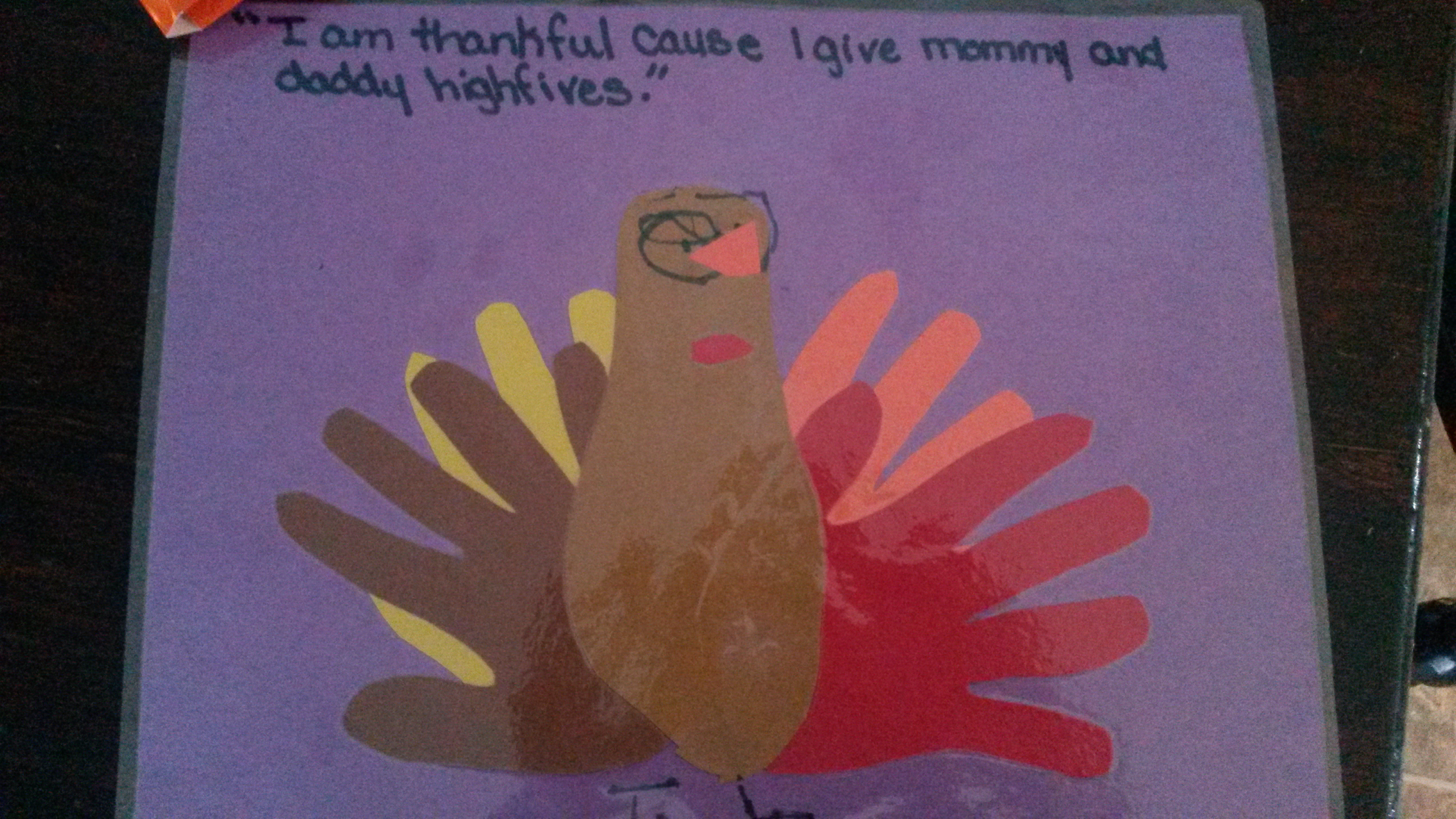
Until your oldest brings home his Thanksgiving project from preschool.

wpid-20151124_130354.jpg

If you can’t read it, that says “I am thankful cause I give mommy and daddy highfives.”

I could quibble with the grammar, but I won’t. (Yes, I will. It should say “because” or, at the very least, have an apostrophe before “cause”; Mommy and Daddy should really be capitalized; and high-fives should be hyphenated.)

That picture up there tells me I’m doing something right.

Excuse me while I take a victory lap and then high-five my son at the end of it.