Meta-Meta-Analysis on Journaling


Is journaling wrecking my creativity?

I’m in another creative slump lately (I know, when am I not) and I haven’t been able to put my finger on why. There’s been the show and the end of school drawing closer, but that doesn’t feel like it — for the last few weeks I’ve had as much time to myself at work as ever. And the slump started before I got really keyed up over that stuff. It started right around the time I started takign time out each morning when I first got to work to write a page-a-day.

Why should that be? I’ve read about journaling dozens of times over the years, and virtually everything I read about seemed to suggest that a bit of unstructured morning writing would be a great way to prime the pump, creatively speaking, to clear out the lines for the juices to flow later in the day. But here I am, flagging on my novel, and — well — just look at the dearth of posts around the blarg of late. Pitiful!

For that matter, I’m not really sure what the journal is doing for me, if anything. Most of what goes into it is irredeemably trite, absolutely worthless, and not fit to be read by anybody but myself, and even then, only at my most masochistic. It’s just me driveling on about any old thing and, a lot of the time, I end up boring myself until I don’t know what to write about. Which, I thought, was why I was journaling in the first place — to kickstart my ideas!

I dunno. It’s only five minutes, after all, and it seems hasty to scrap the practice; with writing, I’ve learned, things sometimes take time to take root, and you don’t always see the benefits right away.

The funny thing is, I wrote most of this post as part of my five minutes yesterday morning. Which is to say that when I turned my attention to my frustration with my creativity and my process, suddenly the thing I was doing to help my creativity and my process actually worked, and I scribbled out a pretty good rant in those five minutes.

So maybe instead of reflecting, I just need to use my morning pages to tear myself a new one each morning.

That seems like a practice I could get behind.

Go Evolve Yourself


There’s a church near me —

No, wait.

At one of the churches near me —

Nope, that doesn’t help either.

Look, there are a lot of churches near me. Living in semi-suburban, semi-rural Georgia. I pass by no less than five on my way to work, and my commute is only about fifteen minutes. (That’s a church every three minutes; way more common than any golden arches ever dreamed of.)

And some of them get pretty clever with their marquee. Credit where it’s due, I’ve gotten more than a couple of chuckles driving past this one particular church.

But this is not chuckle-worthy.

It’s not even smirk-and-drive-on-worthy.

This is veins-popping-from-the-forehead-worthy.

IMG_4621.jpg

I get it, it’s a joke. Haw haw, evolution thinks it has all the answers. (It doesn’t, actually, only lots of answers.) Moms are overworked. (On that one, preach on.)

But it’s a joke that critically fails to understand the thing it’s poking fun at in addition to being just idiotically wrong. Because that isn’t the way evolution works. And evolution *is* true.

Does that make me triggered? Does that make me a snowflake? Well, break out the flannel caps and snowshoes, because I have no patience for this.

Claiming that evolution isn’t true — for laughs or for real — is freaking harmful to society. Empowering people who don’t know any better, who base their arguments off archaic books rather than science you can see with your own eyes, to disagree with the fundamental understanding of the way the world works is bloody anathema to the forward progress of our culture. (And sweet fancy Moses, we need some freaking forward progress right now.)

Claiming that evolution isn’t true is the sort of thing that really should carry a sociological cost, in this day and age. Like stepping into an NRA meeting and suggesting a government buyback on guns, or crashing an LGBTQIA support group and crowing that about Adam and Eve, not Adam and Steve.

Claiming that evolution isn’t true, and telling kids to resist it in schools (I’ve encountered this myself actually, it really does happen), is holding us back.

I’m not saying it should be illegal.

I’m saying anybody seriously representing the idea should be embarrassed.

Terrible Reviews: The Avengers, Infinity War (On Protagonism)


There’s a lot to be said about Infinity War that can’t be said without spoiling some of it. Based on the state of my local movie theater on Sunday morning at 10:30, it’s a little hard to swallow that anybody with a serious interest in seeing the movie hasn’t already seen it, but surely these people must exist.

I have thoughts that must be thought about the movie, though, so here’s the obligatory warning: here there be spoilers.

Furthermore, in the interest of not turning this post into a 3000-word monster, I’m going to break it up. Here, then, is the first installment. With extra spoilers.

On Protagonism:

Let’s get one thing clear: the movie is a thrill-ride. It’s hard to look away (and harder still to walk away, for example when your six-year-old in attendance has to go to the bathroom for the third time just when you feel yet another climactic battle looming) for fear you will miss something, and miss something important. The film is eminently watchable.

But from a narrative perspective, I found myself getting frustrated. Every time you start to settle into the groove with one of the bands of heroes (and the fact that there are multiple bands of heroes is maybe the first indicator that trouble is afoot), you have to cut away for an update on the other bands of heroes. There are at least three — and sometimes four — groups of heroes doing different things in different places until the final battle. And this is a Marvel movie, mind you, in full swagger, using every tool they’ve honed over the last ten years — every subgroup is rife with internal conflict between its members, cheeky one-liners, and hilarious deadpan.

In short (too late!), as an audience member, I am fatigued with protagonists. Who am I supposed to root for and identify with? Banner and his performance anxiety? Thor and his abs? Stark and Strange trying to out-Alpha each other? Captain America and his beard? I’ve seen almost all of the movies at this point, and each of these characters is lovable, so I want to root for all of them — but there just isn’t time. Because the cast is huge and the plotlines are tangled and far-reaching, the film is paced like a coked-out cockroach skittering for the sugar bowl. You can’t identify with a protagonist, you barely have time to recognize them in their shiny new duds (seriously, it’s like every superhero gets a costume upgrade in every sequel) before the movie is shuffling you off to the next thing like an overbooked tour guide. Character development? Forget about it. There are no less than a dozen heroes here — it’s enough work just to remember who’s doing what.

Very frustrating.

Until you shift your perspective.

There’s no consistency to be found amongst the heroes. Some are all business while some crack wise, some concoct elaborate schemes and others wing it. The movie even seems to shift in tone based on who you’re following at the moment. No, the consistency comes from the bad guy.
Related image

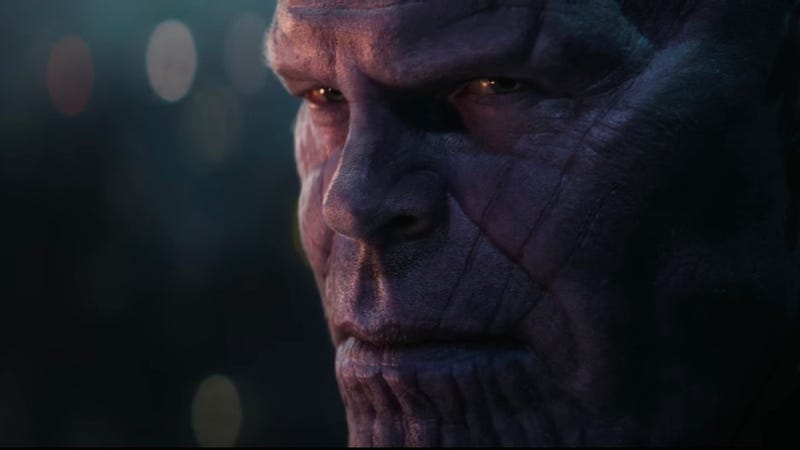
Lurking behind everything that happens is the swollen, ill-proportioned face of Thanos. And once I realized that this movie is pulling a fast one on the audience, I became much more sanguine in my thinking about it.

Thanos is the villain. He’s also the protagonist of the movie.

Thanos hogs the screen time. Thanos has all the character development. Thanos chews on the scenery for every shot he’s in, and thanks to the magic plot devices, he’s literally hiding around every corner. Thanos, in other words, takes the hero’s journey in this movie. Every twist and turn that happens in the movie is centered not on the Avengers — a kicked anthill is as frantic and as useful as they seem to be in the movie —  but on Thanos.

He hears a call to action when his home world is plunged into strife, and goes on a quest to deliver the same peace to the entire universe (just, you know, not in the way we’d prefer). He meets a mentor character who helps him in his goal (Red Skull, we hardly knew ye!) He and his band of villains have all the try/fail cycles. (Didn’t get the time stone there, didn’t get it there — third time’s the charm.) He has to make sacrifices to meet his goal. And the final victory brings him within an inch of his life.

Thanos is the protagonist of Infinity War. And the filmmakers know this: in the closing credits, where we usually get the grim but reassuring message “The Avengers will return,” we get instead “Thanos will return”. That’s not just a cheeky jab to drive home the stake in the hearts of all the Loki fanboys (and fangirls. And the fanboys/girls of Spiderman. And Groot. And Black Panther. And and and YOU GET THE POINT). It’s an acknowledgement that this movie is not about what — or who — you thought it was.

Once you’re down with that, the movie becomes a lot easier to digest, narratively speaking. The quest we’re on is Thanos’s, and the Avengers — legion as they may be — are but speedbumps on the residential suburban street leading to the eradication of half the population of the universe. Our favorites are cannon fodder — occasionally seriously inconveniencing the real protagonist, but ultimately never really standing a chance. Which is the posture of all the villains in every other Marvel movie to date.

I’ll point out that this trick of the light only works because the filmmakers have pulled the cinematic bait-and-switch of turning the Infinity War story into two movies. When Thanos receives his comeuppance, as he must in the next chapter, Thanos’s current arc, which is riding the hero’s trajectory, will come crashing back down to reality.

But once you engage with the movie on its own terms (and failure to meet a story on its own terms is basically the biggest source of strife, not just in Marvel movies, but in any cinematic universe — I’m looking at you, butthurt Star Wars fans), it starts to make a lot more sense.

Some things don’t go on Jell-O


Something happened to me today, and I’m concerned. Partially about the world I live in, partially about the person who did it to me and partially about the whole of reality.

This is not facetiary. (If that’s not a word, it should be. Facetiousness? Get right out of town.) Either somebody I love dearly is losing their mind or the universe I thought I lived in has been swapped out for one where up is down.

So I put it to you, denizens of the internet.

Is jello with mayonnaise a thing?

Because if it is, then first of all, GROSS, and second of all, I don’t think I can live on this planet anymore.

And if it’s not, I have some very difficult decisions to make about my loved one.

Canine Curling


Your dog is smarter than my dog.

I know this because my dog is the dumbest dog living.

Our neighbors are having a yard sale this morning. Lots of cars coming and going, doors slamming, muffled voices from the driveway.

These are all signs our dog (naturally) associates with my wife and I coming home from work. And our dog is the quintessential Attention Whore Dog (AWD for brevity ahead). She has to be in the same room with us at all times. If we step out on the back porch, even just to take out the trash or hose out a litter box, so must she. Going to the bathroom? She’s coming with you (though thankfully she’ll dutifully stop before coming in, and wait with her nose on her paws for you to come out). Headed to the kitchen? She’s on your tail with hers wagging. Cleaning house? She’ll follow you from room to room, simultaneously keeping you in view while keeping her distance from the vacuum cleaner.

All of which is to say that when we come home from leaving her alone all day, she’s a little keyed-up to see us. She greets us at the door, bounding all over the place, sniffing at our crotches, bashing her nose into our low-hanging hands. And she knows to do this when she hears the sounds that indicate we’re coming through the front door: cars grinding to a stop. Doors whumping shut. Muffled voices from the driveway.

And like I said, the neighbors are having a yard sale today — so she’s been hearing those sounds on repeat all morning. So she’s been in a perpetual state of getting revved up to see us without the payoff of actually seeing us so she can let it out and calm down.

But that’s understandable. She’s a dog. She doesn’t know the difference between strangers making those noises and us making them. Here’s why she’s dumb.

When she gets hyped up or stressed out, she doesn’t do typical dog things. She doesn’t chew up our shoes or shred couch cushions or pillows (and I guess we should be thankful for that). She just runs around. She darts from place to place, shoves herself into the tiniest spaces she can find (under the dresser, into the back of the closet, behind the toilet, etc), stays there for about five seconds, then finds a new place. And she forgets how big she is during these forays. So she’ll knock over chairs, rattle glassware on counters, upend lamps.

And for some reason, she’ll dig into her food bowl and just spread it all over the place.

I don’t understand this. It seems like it can only inconvenience her. But it happens every time she gets stressed — we find kibble all over the kitchen, and I do mean all over the kitchen. It’s like she’s playing puppy shuffleboard with it. Or canine curling. (Oh man, just picture it.)

So, needless to say, I found the kitchen just swamped with kibble when I got back to the house this morning.

Fortunately for her, she’s too cute to kill.

20180428_105814.jpg

What do you think? Is your dog dumber than mine? You’re wrong, but I’d love to hear about it.

This post is part of Stream-of-Consciousness Saturday.