I am a teacher, runner, father, and husband. I am an author-in-progress. I'm bad at jiu-jitsu. I know just enough about a lot of things to get me into a lot of trouble.
The fam and I just got back from our vacation to the sunny (actually not so sunny) beaches of South Carolina. Weather was cloudy and overcast with threats of rain each day which actually made the trip delightful — not too hot, no sunburns, and the occasional afternoon cloudburst. Batteries recharged; time to get back to work around here.
Here, then, are five things about vacationing with family.
Kids’ Energy Management. Being back and forth to beaches and pools and outdoor events and sights will wear the kids out. And I dunno about your kids, but when my kids (especially my adorable little girl) get tired, they get angry. You gotta keep their energy up. That means feeding them sugar in irregular large doses. Candy, ice cream, funnel cakes … just shovel it in. Eat meals at odd times. Routine is for the boring. And don’t even think about feeding them a vegetable — this is vacation, for science’s sake.
Your Energy Management. All the problems your kids will have go double for you, because you’re old and tired. Luckily, the same advice also works. Lots of sugar, lots of huge meals at odd times (preferably fried food whenever you can get it, which is always). The golden ticket? You’re grown, so you get to add alcohol to the mix. Do so liberally. Bedtime is for suckers.
Putting the Kids to Bed. Odds are, the sleeping arrangement is gonna leave something to be desired. It is what it is. And if you’ve been doing it right so far, they’re hopped up on sugar anyway. Leave them to their own devices, and they’re gonna invent games to play, babble at each other for hours on end, and otherwise avoid falling asleep. You need help, and the TV is your friend. It’s full of all sorts of programming that will distract and then zonk your kids right out. We discovered that the Weather Channel is excellent for this — their programming is somehow fascinating and boring enough to make you wish you were watching paint dry all at the same time.
Mornings Are The Best Time. I know this never happens, but you might get lucky: since the kids are so wiped out, there’s a good chance they could sleep in an extra twenty or thirty minutes. You might feel compelled to seize the opportunity for a few extra Z’s yourself. Fight this impulse. Morning is a magical time — you just don’t appreciate it at home because you’ve seen it. Away from home, the magic is unmistakable. Have a tea. Meditate. Write. Run. Whatever. You can nap later.
If At All Possible, Get Your Mother Drunk On Margaritas. Man, oh man, the things that will come out of her mouth.
Myrtle Beach, 6 AM. Got the street all to myself. Magic!
The prompt for this week’s SOCS post is open book, point, write. Now that sounds great and funny and creative for most people, but the problem is that our house is run by this little monster and his little monster sister, and as a result our house is full of their books.
Pay no attention to the clutter. We just got home from vacation, so I’m going to pretend that’s the reason for the mess, and that the house isn’t totally like this all the time.
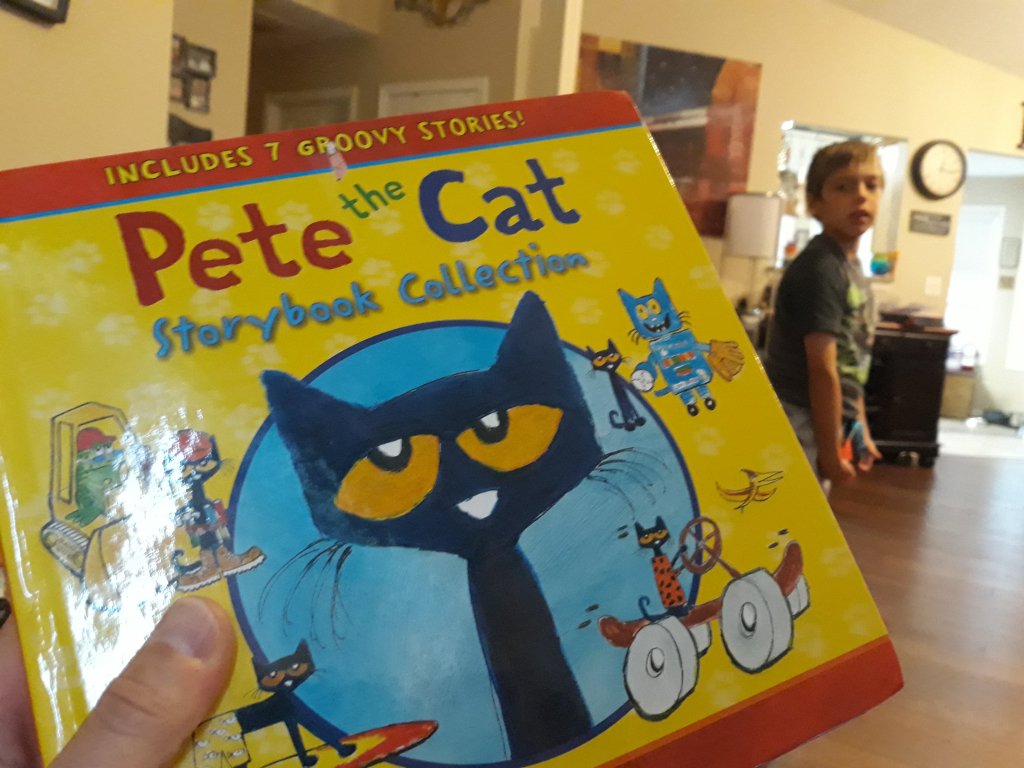
And because the house is full of their books, that literally means that their books are everywhere, so when the prompt says to reach for the nearest book, and you do it in good faith, you come up with this:
AKA “Pizza Cat”
And you don’t get an awesome word like “psychotherapy” or “Mondrian” or “motivation” or “clown car” (sure that’s two words but it’s a great concept in the book I should have reached for: Everything is F*cked by Mark Manson, more on that later). No, you reach for a Pete the Cat book and you get a word like “bat”, and it’s not even a usage of bat that’s fun for a writer to explore like, I dunno, vampire bats or something, no, it’s a literal bat because Pete is literally playing baseball. Not that there’s anything wrong with that, but I hate baseball (almost as much as I hate golf). Still, I’m a good soldier, and the prompt says to use that word, so here I go.
But but but, the prompt is also a Stream-of-Consciousness prompt, which means write whatever comes to mind, and my mind is decidedly not on bats or baseball. So I’m going to remain a good soldier by sticking to the intent of the prompt and going where my mind takes me, which is pens.
Literal pens, specifically, in fact one particular pen in particular, but also pens in the larger sense, the metaphorical sense. (See, if there were a Pete the Cat story about pens, we could have jumped straight to this point instead of all that dithering about with bats.)
Pens are on my mind because I’m having a sort of existential crisis about pens lately, and if you think that’s a silly thing to have an existential crisis about, then obviously you’ve never held a proper pen in your life. (Ok, that’s a little hyperbolic. A little.) Actually, I need to back up.
I’ve been writing by hand a lot over the last couple months, and when you do a thing a lot, you want to make sure you’re doing it right, which is to say, efficiently and, if possible, pleasurably. And while my Pilot G2 pens have been my go-to for years, with all this writing by hand, I wondered if there was a better option. (Writers, let me do you a favor. Stop now, if you value your sanity.) Well, you do a quick google on the issue, and you fall into a hole. Long story short, I invested a ridiculous amount of money in a single writing instrument (though not nearly as much as you could spend if you were of a mind to — the hole on pens goes DEEP) and quickly fell in love with it. It writes so smoothly! It feels so satisfying in the hand! All the good things! Seriously, if you fancy yourself a writer and you haven’t tried writing with a fountain pen, you are depriving yourself.
Thing about fountain pens, though, is they run out of ink and have to be refilled. I planned for this by buying some ink refills when I bought the pen, but I’m too clever for my own good; I took them to work with me (since that’s where I was doing my writing by hand at the time) and left them there. So my super nice pen ran out of ink, and I had no ink with which to refill it.
(Here I must detour to say, I know the amount of thought I’m putting into this is ridiculous. I KNOW. Okay? But again, if you think this is a silly thing to have an existential crisis over, then you obviously haven’t spent any time in a head anything like mine.)
It came time to write this morning’s pages and my fountain pen was down for the count. So I reached for any old pen sitting on the shelf, and I was immediately reminded why I have so quickly taken to fountain pens. The writing felt scritchy, the ink didn’t glide onto the page as smoothly … and as a result, writing my pages was not as much fun as it’s been lately.
Here’s where the existential crisis comes in. I’ve pretty much made it my mantra not to care about brand names, celebrity endorsements, advertisements … anything like that. If it does the job, it’ll work for me has basically become my phrase to live by. I only shop store brands at the grocery store, I order off-brand sneakers … I don’t even know the brand name of the clothes I’m wearing now. I drive my wife nuts because she has wanted to upgrade our almost-20-year-old Camry for years but I wouldn’t dream of it. Why would I? It runs fine. So why am I getting twisted up like hair in a blender about my pens?
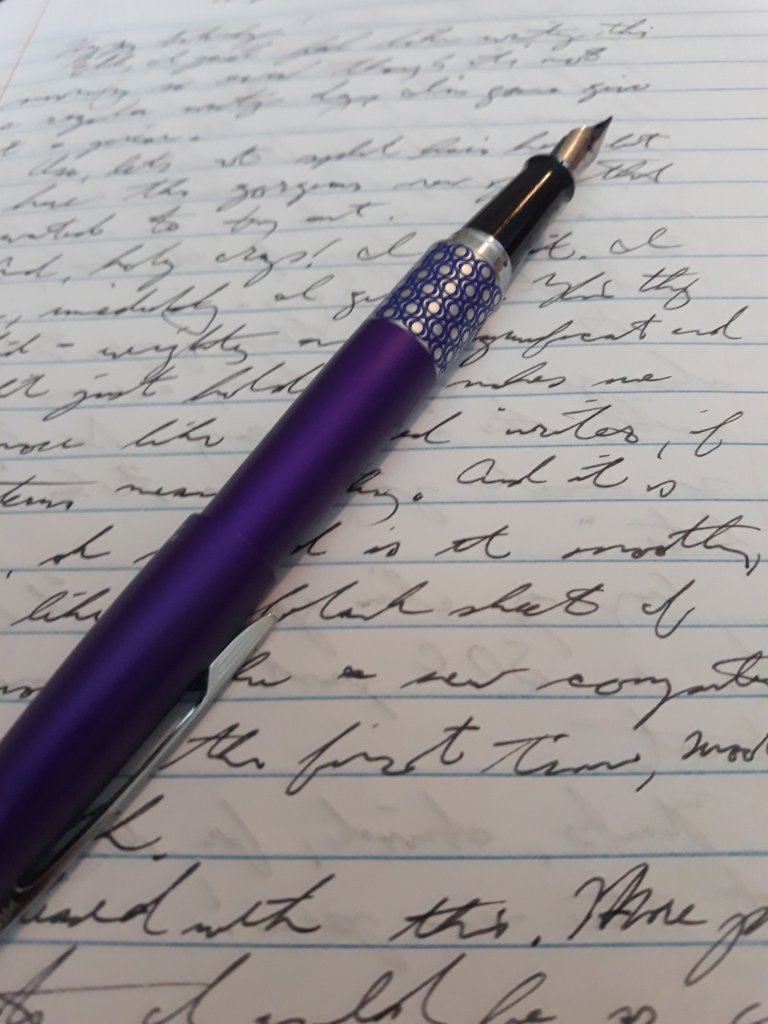
Here, I think, is why: the fountain pen, for one thing, feels really nice to write with. It’s hard to describe, but it literally glides on the page. And when you’re writing multiple pages at a whack, it makes a difference if the tactile experience itself is enjoyable or irksome. Also — the fountain pen just looks like a Real Writer’s Tool. Seriously. Look at that thing!
The weight of it! That nib! (Horrible word, that — “nib” — but who cares, the point of this thing looks like something Shakespeare himself would have used) The user of a writing utensil like this, my brain whispers in my ear, is a user who Knows What He Is Doing When He Puts Pen To Paper. I just feel like a real writer when I use it, and being suddenly deprived of it makes me feel the ever-dreaded less than.
Which is STUPID. A pen no more makes the writer than the clothes make the man (an idiotic expression if ever I’ve heard one). But the heart wants what it wants, and my heart wants my Real Writer’s Pen back. Which is why, even though I dutifully wrote my Morning Pages with an Any Old Pen I found in the drawer, I plan on picking up more ink when I head out later today.
I know, I know. It’s stupid. First world problems in the extreme. What can I say? My brain is broken; this is just the latest example.
The post that I wrote the other day, about Morning Pages? That was not the post I set out to write.
The post I set out to write was this one, but to talk about what I want to talk about here, I first had to talk about my morning pages. What they are, how I use them, my process in writing them. All that is here, but that post turned into a 1500 word gallivant, and my unofficial limit for these things is 1200 words so … yeah. I’ll credit the fact that I was able to rattle off 1500 words on a thing I didn’t even intend to talk about to the fact that my creative wellspring has sprung anew (again, see the previous post).
Anyway. The thing I wanted to explore is this: in my writing, I swear at myself. Like, a lot.Tirelessly. And with great gusto.
The situation doesn’t much matter. It’s equally likely to happen when I’m talking about something I love as with something I hate. I use it to express positive and negative emotion. Basically, I just use it. I love swearing.
Part of it is because I’m of two minds about words that carry a taboo. On the one hand, my critical thinking brain reminds me that words mean only what we agree they mean, and therefore have only the power we give them. (For a lesson on this, I heartily recommend the short story “The Appropriation of Cultures”, by Percival Everett.) Being an atheist helps, here; there’s no higher power dictating that this word is bad and this word is good and this word if spoken earns you a one-way ticket to eternal torture. Words are just collections of letters and sounds that we as a culture agree mean certain things. On the other hand, our culture has certainly agreed that there are words you shouldn’t use in polite company. And since my job in large part entails cultivating future humans into actual productive humans, that’s a standard I’m more-or-less obliged to uphold.
That’s why I take pains not to swear (too much) in my online interactions; even though my online persona isn’t necessarily identical to my walking-around persona, they’re close enough that it behooves me to be cognizant of the things I say around here. I keep a lid on the things that would otherwise come out of my mouth.
But in my not-for-public-consumption writing? In my morning pages, my first drafts, my notes to myself in the margins of my writing projects? The lid comes off. If the use of certain words could condemn you to eternal torture, I would probably owe several infinities’ worth of torture to whatever loving deity were meting out the torture. I call myself rude names. I lambast the things I’ve written. I call myself out for the things I need to write in future drafts. It’s self-abuse of the most vile kind, except I don’t view it that way. It doesn’t make me feel bad when I read over it again — it makes me laugh. It’s just how I talk to myself. It’s the opposite of a Big Deal; my own private joke with myself on the public-facing me who can’t speak or write that way.
And it made me wonder how other people do the same thing. Not if — because I feel it’s a pretty safe assumption that anybody who does any sort of extended self-talk, via journal, notes to self, or otherwise, has their own style of idiosyncratic talking to themselves — but how.
Benjamin Franklin by David Martin (1737-1797). Pennsylvania Academy of the Fine Arts, Philadelphia
I remember that I had to read The Autobiography of Benjamin Franklin in a college course, which contained several excerpts from his journals, his lists of personal maxims, stories of his early writing jobs. And I remember thinking: personal journals? Bull Sharknado. Maybe some polished versions, sure. But it’s not like he went into whatever random entry he wrote to himself on Bleptember the blargteenth, schleppenteen schlippity bleven, said “yep, that’s the one” and dropped it into the book. You just know that the margins of his journal were full of comments like “Ben, you self-important, pompous, wig-wearing f***. How can you take yourself seriously writing this s***?”
Right?
No?
Maybe it’s just me.
Anyway, I wrote this entire entry to tell you about that one weird little thought that crossed my mind: Ben Franklin scribbling insults at himself with a quill pen in between drafting the backbone of our nation.
I know, I know! I start these things and go off them, and start and go off, like a chronic yo-yo dieter with short-term amnesia, like a kid climbing on and off the high dive pretending he’s really gonna do it this time. I’ve tried bullet journaling (god, I hated it so much) and plain ol’ page-a-day, write-about-what-happened-today journaling (not bad but felt more like a chore without a payoff than anything beneficial). They only lasted for a few weeks each. But I actually think I might stick with it long term this time, and I think it’s because I found a journaling system that seems to be working for me.
Here’s that system.
What I’m doing for my daily journaling (well, 5-6 days per week journaling, a man deserves his weekends off, don’tcha think) are Morning Pages, popularized by Julia Cameron. Some time ago I actually wrote a post about how I was given one of her books about process and creativity: I got frustrated and annoyed with her endless romanticization and frippery about writing and gave it up. But the more I read into the habits of the successful (and especially of the successful creative), the more I heard Morning Pages mentioned. So I re-looked them up and gave them a try. I’ve been doing them for a solid six weeks, and I’m pretty sure I read somewhere that you need thirty days to form a habit, so obviously I’ve got this one sorted.
Anyway, a brief explanation. Morning Pages are not journaling per se.
Sorry for the detour. WordPress apparently doesn’t recognize “journaling” as a word so it’s underlining it in red all over my draft, which is really futzing up my zen for this particular session. I’m irked, but I hereby release the irkitude. Carry on.
You know how when you wake up in the morning and the first thing you have to do is head to the bathroom? Me, (not that you asked but I’m in that kind of mood) I like a nice feisty deuce in the morning. Partly because physiologically it has to be done, partly because I guess I’m conditioned. Anyway, I like getting it out of the way early. Cleans me out, lightens the load, I can go on with my day. Morning Pages are like that, but for your brain.
In short, you wake up, do your bathroom thing, and before you let too much time pass, you sit down and write. You can write about whatever you want, whatever’s to mind, but you have to write three pages. And you have to write longhand. No typing.
It’s a brain dump. And it’s working for me.
Now, I’m not hyper-adherent about it. I do mine when I arrive at work, when I have a little time to myself. I’ve gone for a run, gotten the kids off to school, kissed the wife goodbye. (Technically you’re not even supposed to do all that stuff — you’re just supposed to roll off the mattress and embrace the blank page. Fargo that, I say. You take a thing and you make it work for you. I’m already waking up before 5 AM on run days, I ain’t waking up thirty MORE minutes early.) I come in, set my stuff down, start a bit of music on the computer (https://www.youtube.com/watch?v=hHW1oY26kxQ is my playlist of choice the last few weeks), start the electric kettle for my cup of tea, then I crack open the notebook, ready my pen, and set about writing.
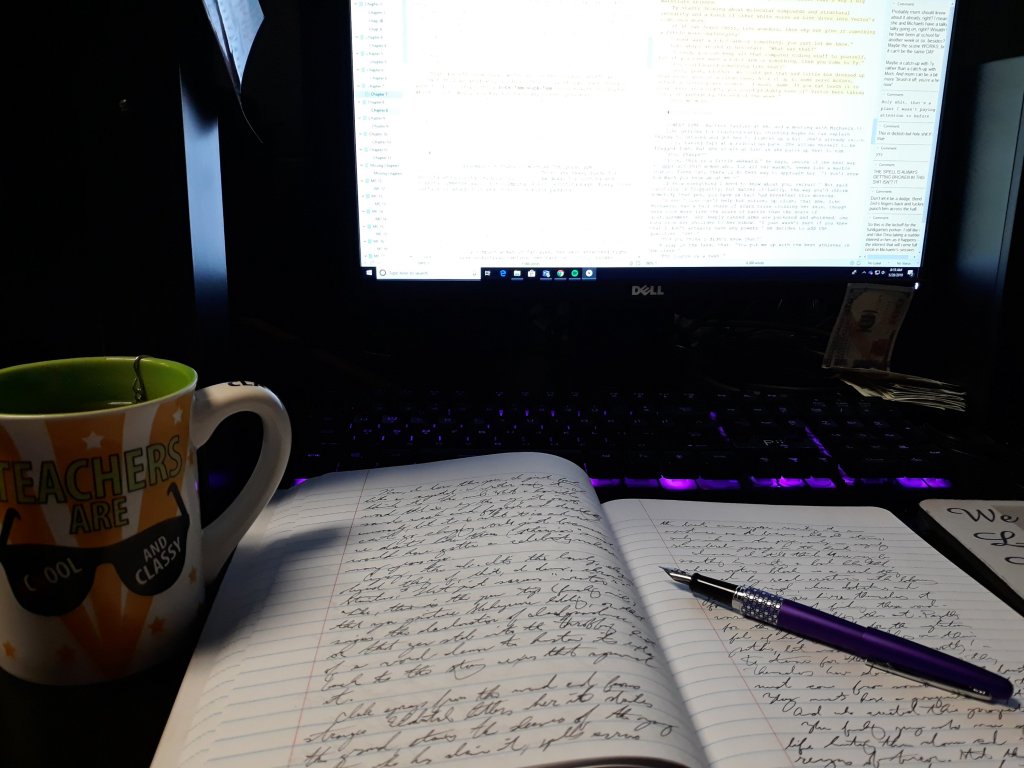
Pictured: A cuppa tea, my Morning Pages, my new fountain pen, my project ready-to-go in Scrivener, and a fat stack of (fake) cash because it’s still hanging around my office for some reason even though we closed our show a month ago. THIS IS WHERE THE MAGIC HAPPENS.
I write about my worries for the day (and boy do I have a lot of those! Speaking of which, I’m still scaling back on the meds. That’s going great. Maybe I can post about that later). About what I’m thinking about. What irks me. What excites me. Sometimes a story idea will bloom in the middle of writing and I’ll noodle that around, invent a character and let her splash around in the tidal pools of my brain farts for a few lines. I’ll roll in other journaling ideas, like jotting down things I’m thankful for, things to focus on for the day.
You notice that the things I write about are diverse. They sort of have to be. Because to just sit down and write three pages without having a central topic to write about is … well. It can be tough. Inevitably one starts to doubt one’s self: This is dumb. Why am I even thinking about this, much less writing about it? Who even cares about this? I’m literally just vomiting words onto the page. Blah blah blah blah blah blah blah. (I’m pretty sure I actually wrote two lines of just the word “blah” once — that’s how stuck I got.) But that’s kind of the point. One of the only rules about Morning Pages is that you’re not supposed to stop writing. Don’t stop to think about what you’ve just written. Don’t stop to think about what you’ll write next. Just press on. And in that regard, Morning Pages become a mighty tool.
When you take away the ability to stop, to pause, to critique and evaluate, then you must embrace the necessity of writing literally whatever comes to your mind. Mind’s a blank? Write about how your mind is blank. Distracted by an odd smell coming from the next room? Write about how it makes your nose wrinkle in disgust. The process is meditative, in its way. You express what’s front-of-mind and tune out the rest. And when you have to fill three handwritten pages, well — your mind tends to wander a bit. Morning Pages allow you — nay, force you — to wander with your thoughts, to explore what’s lurking in the subconscious brain, to get down on paper what’s clanging around in your skull so you can move on from it.
Further, there’s a concept in exercise called “greasing the groove”. In short, it entails working out at a capacity significantly below what you’re capable of to improve muscle memory, so that when you do go hard, the muscles are better tuned-up. Morning Pages are that, all over. The stakes couldn’t be lower, as I’m certainly not sharing them with anybody for proofreading. It doesn’t matter if I make grammatical mistakes or swear my entire face off on the page (something I actually try to be careful about here on the ol’ blarg). Writing a whole bunch where the stakes don’t matter gets my brain tuned up for the more important writing where my plot, characters, and general goodness or badness of the story do matter.
The first few times I did Morning Pages, it took me about half an hour. I kept stopping and starting, second-guessing myself and the process, allowing myself to get distracted and zone out. Lately, I crank ’em out in about fifteen minutes, which is basically as fast as I can reasonably write them. And yeah, I could certainly finish faster by typing, but there’s something that’s almost, but not entirely unlike, magic about actually creating words through the motion of your hand. It’s slower, but I like it. (Especially since I got my new pen.) It forces you to connect with the words more than typing does. It’s hard to explain.
Anyway, I write my three pages, then close the notebook and don’t think about it again for the rest of the day.
And it’s incredibly freeing! For one thing, the process triggers that same “I DID SOMETHING” dopamine rush that exercising first thing in the morning does. You get that zing of having written three pages, and hey, the rest of the day seems that much easier to face. Plus, it stimulates the brain like hooking up jumper cables to a dead battery. Writing about my worries, my to-do list, my whatever — it forces me to focus thought on those things, and often, answers and motivation are the result. More than once has it happened that I poured out a problem into my Morning Pages — a snag in the story, something that was bothering me about a colleague, a messed-up situation that was driving me nuts — and an answer takes shape just from writing about it.
I feel better immediately after writing my Morning Pages. And that helps me set a good trajectory for the day.
In that vein, I want to posit: it’s no mistake that I’m back to working full-steam on my current novel in the weeks since I started doing Morning Pages. Just reminding myself that, yes, I’m capable of the physical act of writing, seems to have, if you can believe it, reminded me that I’m capable of writing, of fixing this story, of pushing through a roadblock.
In short, writing my daily Morning Pages sets the stage for a good writing day, and anything that does that is welcome in my world. Julia Cameron may be a bit of a ridiculous hippie but I think she’s got something with this practice.
Have you tried Morning Pages? Do you journal in a similar way? I’m always curious to see how other people are making it happen.
Around this time of year, the ol’ blarg here sees an uptick in traffic vis-a-vis this one post in particular: Tips for Writing a Graduation Speech. No great mystery, that. It’s graduation season. There are speeches to be given, and for a lot of these poor souls, it may be the first real speech they’ve ever given. Woe to them, but even more than that, woe upon their audiences.
I wrote that post five (help!) years ago when I was in full English-teacher mode, and I stand by those tips for the writing. If you’re gonna give good speech, you’ve gotta start with good words. But there’s more to a speech than just good words, and that’s what I want to talk about today, since I have rediscovered myself as a drama-teacher-slash-acting-coach. And that’s your delivery.
Your stilted, stiff, boring-AF delivery.
You know it, I know it. You go to YouTube and you watch your average graduation speech (or, god help you, you paid attention to the end-of-year speeches last year and now it’s your turn), and it’s entirely interchangeable with any other given graduation speech. The words could be entirely different but the delivery sounds exactly the same, because these poor bastards don’t know the first thing about giving a speech to an audience.
Well, that’s not going to be you, my soon-to-be-putting-high-school-in-the-rearview-mirror friend. You’re going to give a speech that, even if it doesn’t shake them to the very core of their cold, dark souls, at the very least it’s not gonna bore them to tears while they’re listening to it. Because you’re going to prepare for this speech like an actor, and I’m gonna tell you how to do exactly that.
Ready? Me either. Let’s dive in.
Who are You? No, seriously, who are you? Read the speech you’ve written. Out loud. Does it sound like you speaking? If not, it’s probably because you’re trying to make your speech sound like every other graduation speech out there. Which means you sound phony and cliched. Which means you have a problem.
But, for real though, Who are You? If you’re a quiet, dry humor type, it’s no good giving a speech full of puns and goofy jokes, or worse, a deathly-serious seize-the-day type diatribe. Your friends and family in the audience know you, and they’ll recognize that you’re putting on airs if you go down that road. But even those who don’t know you can smell a phony a mile away. Check yourself and re-write the speech if it’s not your style.
Breathe. The mind and the body are connected, for better or worse. The one can’t get by without the other, and your brain needs oxygen to function at full steam. So before you begin, do your brain a favor and focus on your breathing.
I’m not joking. Stop and breathe. You skipped the last step because you thought it was a waste of time, right? I know you did. You didn’t train as an actor, and this “just breathe” stuff is a bunch of hippie-dippie baloney. But I’m saying it again because it bloody well matters. Stop what you’re doing, stop rushing from one line to the next. Take a deep breath. Deep, down to the bottom of your lungs. In through the nose, out through the mouth. Close your eyes if it helps. Don’t think about the next thing you have to say. Think about taking a deep breath. Then take it, and focus only on that breath while it’s coming in and going out.
You still aren’t breathing, dammit. Stop playing around. I know this sounds like hot nonsense, and if that’s your mindset, it will be hot nonsense. Stop thinking about what you’re about to say and just breathe. Count to ten if it helps (focusing on numbers, or anything really, is a great way to block out other things — like anxiety and doubt). Do it. Just breathe, before you do anything else.
Relax. A few steps ago, I talked about the mind-body connection. You fed your brain when you took those deep breaths. (If you didn’t take those deep breaths, back up a few steps and TRY AGAIN.) It’s time to hack the system from the other side. Before you take the stage, relax the body. Lots of us hold tension in the shoulders. Tense and relax them. Likewise the muscles of the neck and jaw. Tense and relax. Scan the body, from toes to the top of the head. Wherever you find tension, tune in and relax it. Tension in the body takes up real estate in your brain, and you want as much brain power as you can get.
Rehearse to exhaustion. There’s no substitute for repetition. You have to know your speech backwards and forwards. I’m not saying don’t use notecards — by all means, use notecards to keep yourself on track. But you should know your speech well enough to cover 90% of it without even looking at your notes. If you don’t know it, and I mean know it the way you know how to brush your teeth or wipe your butt — which is to say, well enough to do it in your sleep, or if your hair is on fire — you’re gonna blank on it when you’re at that podium with a thousand or more sets of eyeballs trained on you. Archilocus said that “People don’t rise to the level of their expectations; they fall to the level of their training.” Be well-trained.
Make breathing and relaxing a part of your rehearsal. If breathing and relaxation are normal, regular events for your body, then the body will respond to the effects of those exercises much more quickly. Kind of like turning out the lights and brushing your teeth and bathing in the blood of your enemies cues the body that it’s time to go to sleep for the night, if you practice relaxation, you can relax the body with just a few seconds of focus. Like having a chill-pill on demand. Neat trick — but it takes work on the front end.
Don’t speak like a robot… I don’t know why, but when the uninitiated get up to speak in front of a crowd, it’s like they forget how people actually talk. They feel like they have to emulate MLK or JFK or some-other-K and they fall into this voice. You know the one. The one that’s loud, so that’s great, but that also has all the emotion stripped out of it in favor of a forced affect that “sounds emphatic”. That odd cadence that isn’t quite Shatner-esque but that isn’t far off, the forced anti-melody that starts high and finishes low on every sentence. That plodding pace from start to finish. Know what that does to people? It puts them to sleep.
Speak like a human. Ever actually listen to people speak? Not, like, to understand what they’re saying, just to listen to the music of their voices? Try it sometime. Listen to the patterns, to the ups-and-downs, to the way they use just their voices to add emphasis. Then emulate what you’ve learned. Okay, not in the sense of I-want-to-sound-like-this-person-when-I-speak, but rather in the sense of speaking conversationally. To help with that …
Don’t speak to the “crowd”… I’m not gonna say that one of these steps is more important than the rest, but if one thing was the most important in the list, it might be this. There’s a tendency to think you’re speaking to a crowd. That’s true, but the fact is, you don’t know the crowd, so you can’t speak to the crowd. And for that matter, when people speak to crowds, they tend to put on a manufactured voice. (See above.) Don’t do that crap. Don’t try to speak to everybody. Instead...
Speak to one person. A friend, a parent, a mentor, a younger sibling. Speak truthfully and honestly, as if you were speaking only to that one person you know very well, and your speech will ring true. Genuine. Not fake.
It’s okay to pause. For one thing, real people pause in conversation and — flash back a few steps — we’re going for conversational, here. (Unless you happen to actually be the next coming of MLK, which you aren’t.) Pausing creates what I call for actors “think-time.” Which is exactly what it sounds like. Time for you to think about what’s coming next. Also time for the audience to think about what you just said. Time for us to enjoy a moment of silence for once. As a speaker, it’s not your job to bombard our ears with words until we capitulate, it’s your job to communicate a message to us. We understand messages better when we have time to think.
Hold your place. Here’s an actor’s trick I love. I teach it for cold readings (wherein actors have to use a script but are expected also to show emotion and listen to their partners) and it’s even easier for you since you’ll be standing at a podium. As you speak, mark the next thing you need to say with your finger. This works if you have the whole speech printed out or if you just use bullet points. When you’re comfortable, or when you’re pausing, or while the audience is laughing (at the joke you just told, hopefully), mark the beginning of your next sentence or your next point. Seriously. Just plop your finger down on the page. The podium is hiding your hands anyway. That way when you’re ready for that next idea, you don’t have to look for it on the page — it’s right there ready to go.
Not to be repetitive, but — don’t forget to relax and breathe. Everybody gets stage fright. Everybody freaks out a little bit. Or a lot. But the actor’s tools are the breath and the body, and if you can master those things, you can master and tame the panic when it tries to take over. Just breathe, and keep breathing.
I promise, I’m not gonna do another graduation-speech related post around here, ever, because with this one I think I’ve tapped the topic out. That being said, I think if you take these tips to heart, your speech will be better than most of the speeches being given at most of the schools around most of the country in the coming weeks, and there’s something to be said for that. And as always — if these tips help you out, I’d love to hear about it.
Welcome. This is my page for sharing projects associated with my coursework in Media and Technology at the University of West Georgia. Assignments will be posted here as they are completed.



 Accidentally Inspired